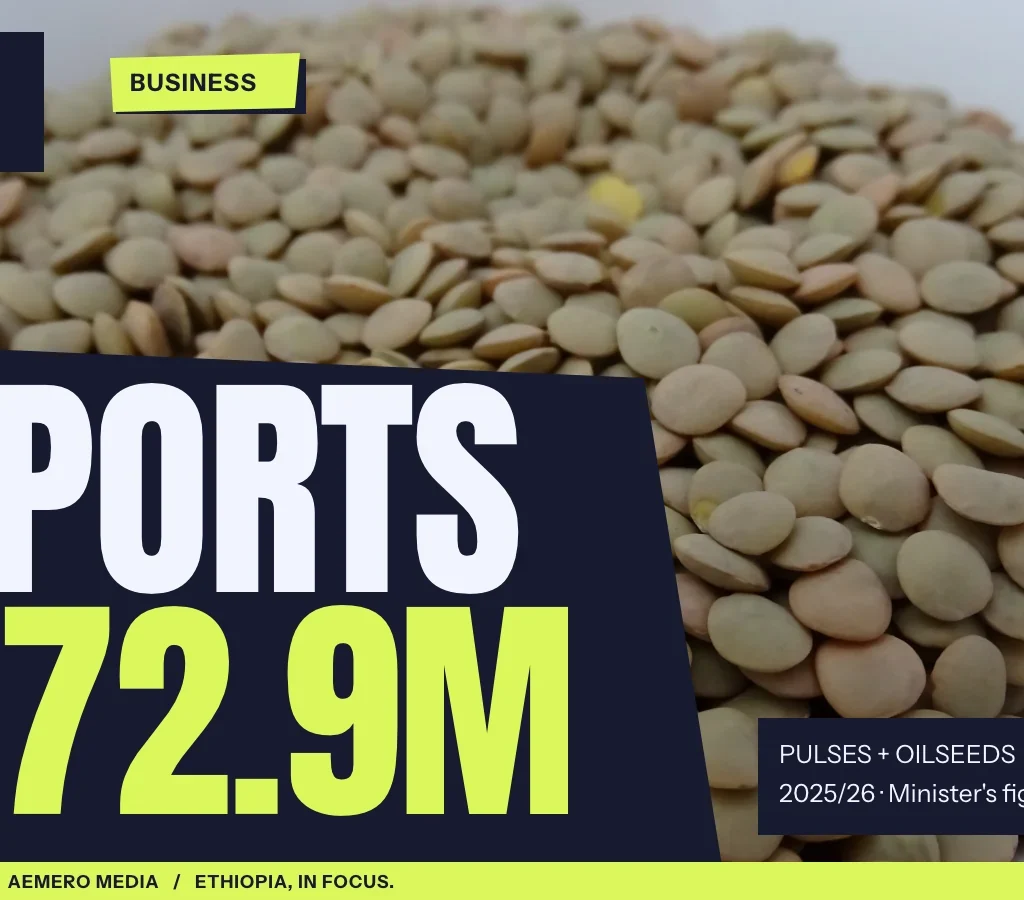
Ethiopia earned US$572.9 million from pulses and oilseeds exports in the 2025/26 fiscal year, Trade and Regional Integration Minister Yasmin Wohabrebbi said at an industry conference in Addis Ababa on 24 November, according to Fana Media Corporation.
The minister put the sector’s contribution at approximately 5% of Ethiopia’s US$11.2 billion in total export earnings. She made the announcement at the opening of the 15th International Conference on Pulses and Oilseeds, held at the Science Museum.
What the export figure tells us
The US$572.9 million figure combines pulses and oilseeds. It should therefore be read as a sector total, rather than the earnings of sesame, lentils or any other individual crop. It also describes export revenue, rather than the profit retained by farmers or exporting companies.
Those distinctions matter when judging performance. A larger export receipt can reflect price changes, sales volumes or a different mix of products. It does not, by itself, show how the benefits were distributed along the supply chain.
Higher shipments, lower reported earnings
In separate reporting published on 24 November, Birr Metrics said the sector’s earnings were approximately 6% below the previous year’s figure of more than US$610 million. The publication reported shipments of roughly 555,000 tonnes, nearly 5% higher than a year earlier, and attributed weaker revenue partly to lower international commodity prices, particularly sesame prices.
Birr Metrics also reported that the combined sector fell short of a US$743 million annual target by about US$170 million. These comparisons come from that publication’s reporting; they are distinct from the latest earnings figure attributed to the minister.
The practical implication is that moving more produce does not necessarily bring in more foreign currency. Exporters have to consider the price received per shipment alongside transport, handling, processing and financing costs. Revenue and profitability answer different questions.
Where the minister sees room for investment
Fana reported that Yasmin identified contract farming, produce aggregation, warehousing, edible-oil manufacturing, food processing and packaging as investment areas. Her stated priorities included productivity, product quality, traceability, stronger processing capacity and access to additional markets.
For an Ethiopian business, those areas represent different entry points. Storage and aggregation concern the movement of produce from suppliers to buyers. Processing and packaging concern the form in which a product is sold. A viable proposal still needs an identified customer, a reliable supply arrangement and a realistic cost calculation; a policy priority is not an assurance of commercial success.
Read the figures alongside Ethiopia’s wider export trade
For broader context, see Aemero’s guide to Ethiopia’s major export products. Our report on coffee export earnings between July and October 2026 covers a different period and should not be compared directly with this full-year sector total.
Lentil photograph: sandravelez2017, via Wikimedia Commons, CC0. Cropped and combined with Aemero Media artwork. This is a contextual commodity photograph, not a photograph of Ethiopian export consignments or the conference.