The Bulgarian Embassy in Addis Ababa is accepting proposals for healthcare and education projects in Ethiopia starting in 2027. Applications close on 1 December 2026; the official call gives no closing hour.
Who can apply and what is funded
Eligible groups include Ethiopian public bodies, municipalities, educational, health and social institutions, international humanitarian organisations and local or international NGOs. The call also names the African Union and its specialised bodies. Applicants must meet its registration, project-history and previous-grant compliance rules; organisations registered for less than two years are excluded. Only one proposal is permitted per applicant.
Priorities are pandemic-ready healthcare and inclusive, quality education, including lifelong learning. Project budgets start at €10,000. Recommended maximums are €50,000 for goods, services or construction, and €15,000 for conferences, seminars and similar activities, with the latter limited to nine months. Co-financing is an evaluation advantage.
Timing and payment conditions
Projects must start by 1 June 2027 and finish by 31 December 2029. The call provides staged payments of 50%, 40% and up to 10%, subject to reporting conditions. Independent audit and visibility activities are required.
How to apply
Complete the official application form in Bulgarian or English. Email it in both PDF and Word formats to [email protected]. Check the full call for all conditions before submission.
Build the proposal around a specific service gap
Start with the people your organisation serves and the change you can realistically deliver. An education proposal, for example, would be clearer if it explains which learners are being missed, what prevents their participation and how the proposed activities address that barrier. Buying equipment is an activity; explaining who will use it, who will maintain it and what service it improves makes the case for the purchase.
For a healthcare proposal, describe the institution’s existing capacity and the gap the project addresses. Distinguish the work your organisation will deliver from contributions that depend on another institution. If a partner must provide staff time, space or permission, establish that arrangement while preparing the application.
Check that the budget can support delivery
Match each budget item to an activity and a result. Think beyond the initial purchase: equipment can require installation, training, consumables or maintenance. Explain how any continuing costs would be met after the grant-funded work ends, rather than assuming a future grant will cover them.
The payment schedule also matters for cash planning. Before applying, assess whether your organisation can manage the timing of payments, reporting and expenditure. Separate what the donor will finance from any contribution your organisation or partners would provide. These planning suggestions do not replace the call’s eligibility and cost rules.
Organisations working on environmental projects can also compare Aemero’s coverage of the UNDP/GEF Small Grants Programme Ethiopia call. It has a different purpose, eligibility criteria and application process, so assess each call separately.
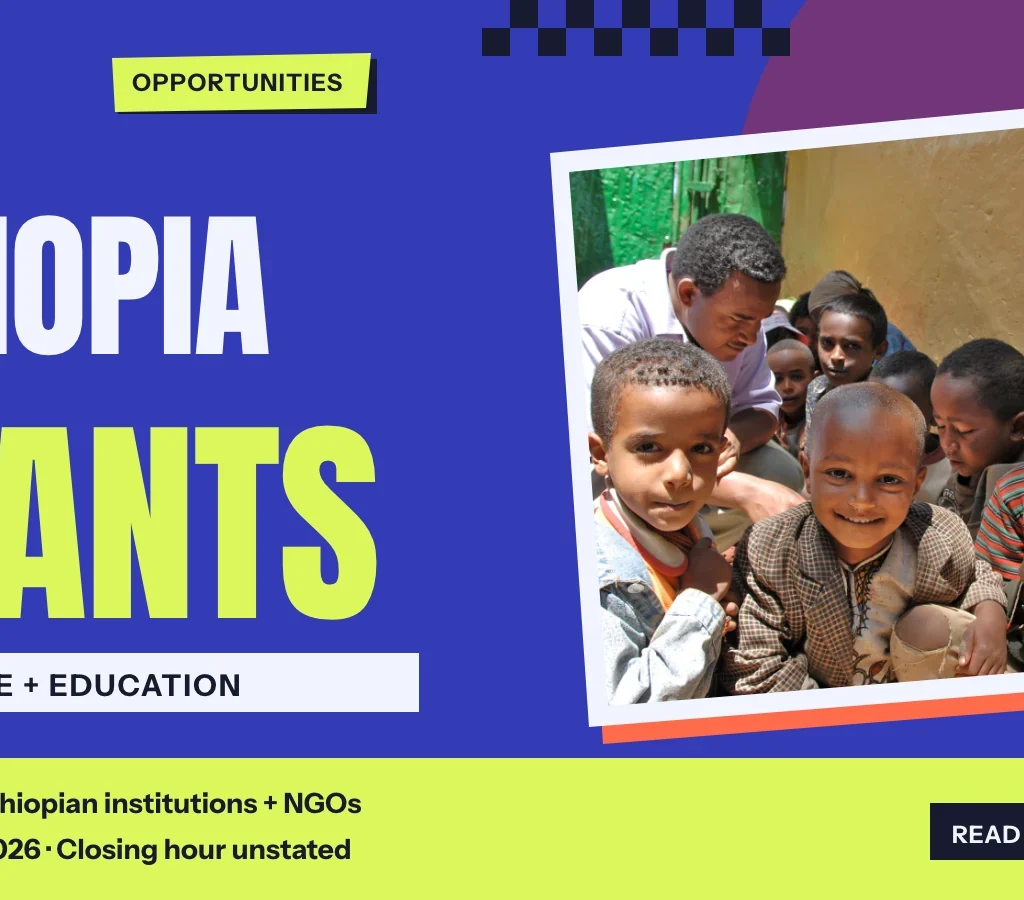
Archive photograph: Dave Proffer, school visit on Entoto, 16 March 2007, CC BY 2.0. Cropped and combined with Aemero Media artwork. The photograph illustrates education in Ethiopia and does not identify a beneficiary of this grant call.