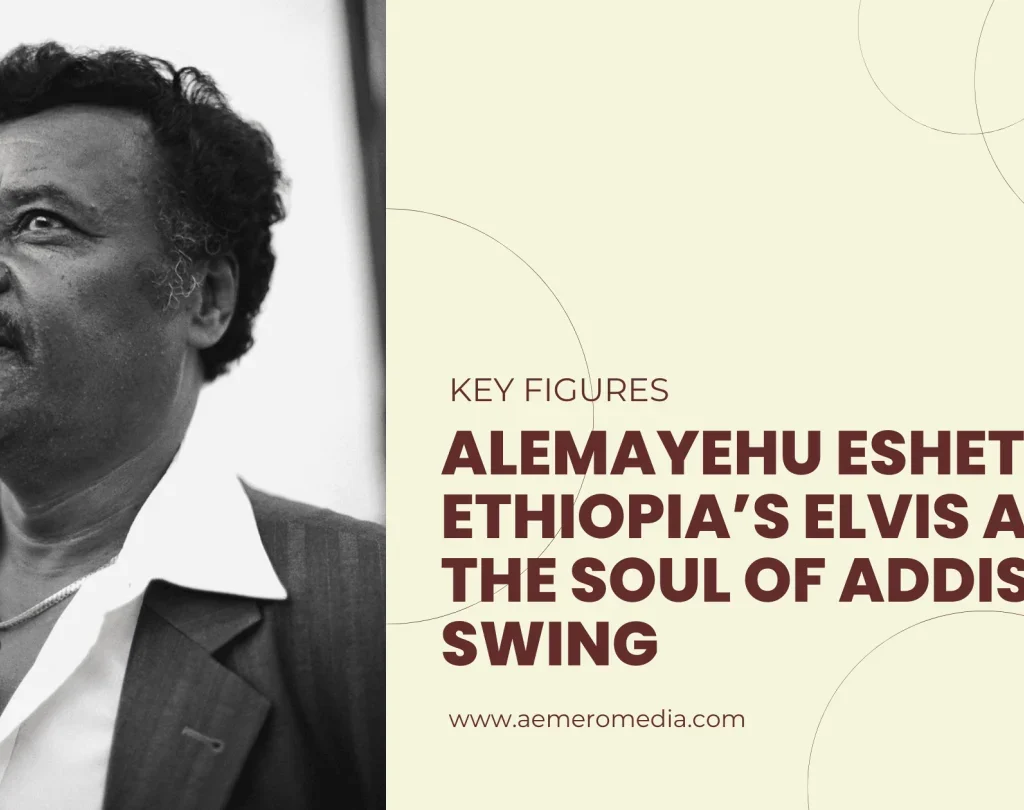
Alemayehu Eshete could turn a line about Addis Ababa into something you could dance to and still hear as a song about home. “Addis Ababa Bete” is a place to start: the singer gives the city its name early, and the arrangement lets the phrase come back with a different emphasis. His records are often introduced with the nickname “Ethiopian Elvis.” Listen past the nickname and you hear a singer who used the placement of Amharic words, repeated horn lines and changes in tempo to make a song his own.
The Police Orchestra and the Addis bands

Alemayehu came up through the Police Orchestra, one of the institutional bands that trained musicians and put them in front of Addis audiences. In this scene, singers could work with musicians versed in arranged brass parts and dance rhythms. His career also crossed into private recording, where the same voice that could fill a stage had to carry a song across the two sides of a small record.
The Ethio.Music career profile traces his path from the orchestra to commercial singles and later reissues. The Buda Musique edition of Éthiopiques 22 describes the influence of American rock and soul on his performing style. Those influences are easiest to hear in how he attacks the start of a phrase and drives into the band’s accents. The melodic shapes and Amharic phrasing remain central.
Amha Records and the 45-rpm era
Much of the material listeners now hear on streaming services was recorded as singles. When an album title includes years such as 1969–1974, those years refer to the recordings it gathers. The compilation came later. That distinction matters when looking for a particular original recording, because the same title can appear with different transliterations and in different editions.
A useful early record to look for is the 1969 Amha Records single “Timarkialesh” / “Ya Tara.” In the 1970s, Alemayehu also worked with the arranger and pianist Girma Bèyènè. The two artists’ names appear together in the credits for Éthiopiques 22, a place to hear that partnership in the surviving recordings.
“Temar Lije,” also listed as “Temar Ledje,” is one of the records most closely associated with the early period of Amha Records. Start with its lean guitar and horn figures, then listen to the way Alemayehu pushes the ends of his phrases. In “Addis Ababa Bete” the melody can hold a listener’s attention without the same attack. The contrast is a better introduction to his range than a list of artists he resembled.
Which Alemayehu Eshete records should you look for?
Éthiopiques 9: Alèmayèhu Eshèté, 1969–1974 is a 22-track Buda Musique collection. Use it as a broad introduction to his singles from those years. The record is long enough to hear both the driven performances that earned him his nickname and the measured delivery he could bring to a slower song.
Éthiopiques 22: More Vintage! is a second collection with its own recordings and liner notes. It includes “Tèmar ledjé,” “Nèy-Nèy wèlèba” and two takes of “Ambassel,” one slow and one fast. Try both takes to hear how a change of tempo gives the same song a different feel. Look for the credit on the specific track when you want to identify the band or a collaborator, because the personnel and recording circumstances vary across the collections.
In 2017, Philophon released “Alteleyeshegnem” backed with “Temar Ledje”. These are later recordings of older songs. Compare that version of “Temar Ledje” with the recording on Éthiopiques 22 before deciding which one you remember. On streaming services, try both Alemayehu Eshete and Alèmayèhu Eshèté when searching.
Why these records still reward a close listen
The easiest way to hear what Alemayehu brought to an arrangement is to play “Temar Lije” and “Addis Ababa Bete” back to back. Notice when the band leaves space for him, and when he meets an instrumental accent instead of singing over it. Then play another singer from the same period. The horns and rhythm section may sound familiar, but the way Alemayehu pulls or presses a phrase changes the whole recording.
Our Ethiopian music listening guide puts the recordings in the wider scene. The Aster Aweke album guide follows a later route from the Addis stages through Ethiopian diaspora recordings and international labels.