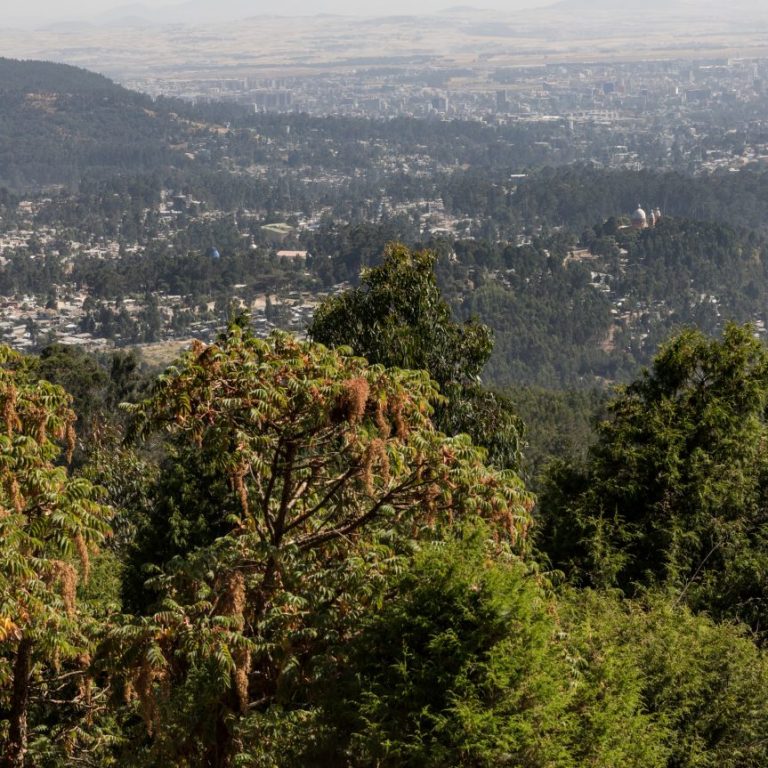
Biete Amanuel, the House of Emmanuel, stands in a rock-cut courtyard in Lalibela. The church belongs to the southern group of the Lalibela rock-hewn churches. Its most distinctive detail is on the outside: horizontal bands and recessed windows make a stone building look as though it were assembled from layers of wood and masonry.
Read the façade from the base upward · What the resemblance tells us about the church’s date

What makes Biete Amanuel monolithic?
The builders isolated a mass of rock by cutting a trench around it. They shaped the outer walls and hollowed out the interior while leaving the roof and structural parts in place. The church and its courtyard are therefore two parts of the same excavation. Visitors can see the relationship from the rim of the courtyard before descending.

The older building tradition behind the façade
The façade evokes the construction of ancient Aksum, where stone walls incorporated timber. At Biete Amanuel, the bands and projections imitate those structural details in rock. The Metropolitan Museum of Art’s study of Aksumite architecture compares the church with earlier palace designs. The resemblance reflects a building tradition that was still meaningful centuries after Aksum’s political decline.
What to look for in the courtyard
Look at how the wall changes around the door and windows. Recessed frames give the façade depth, while the continuous horizontal bands pull the different sides together. The narrow space between the church and courtyard wall makes it easier to appreciate why the builders had to plan the two together.
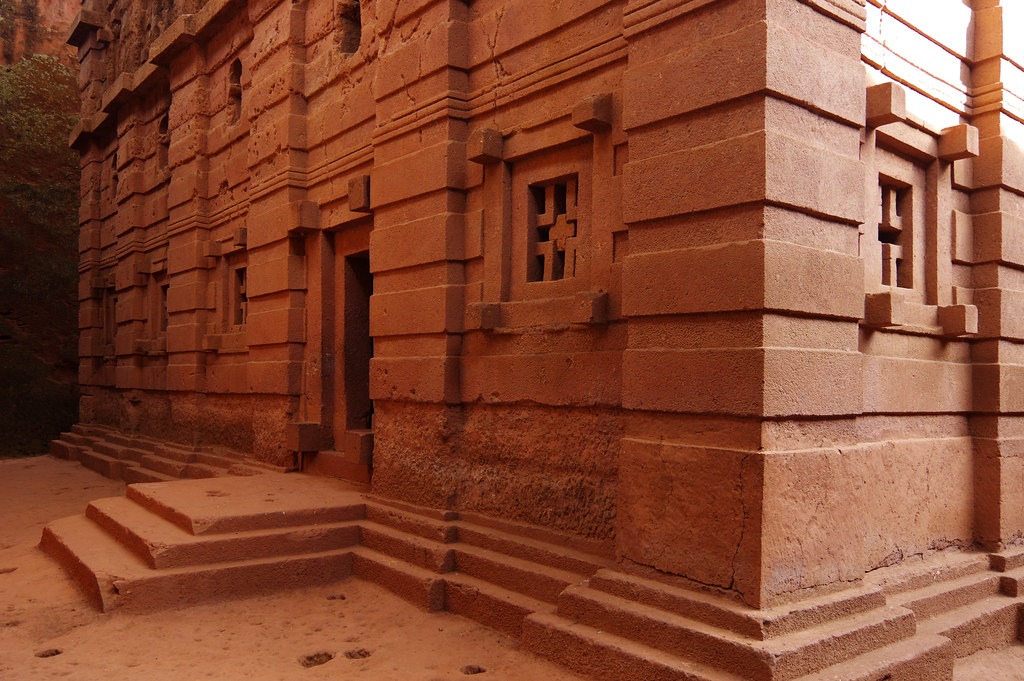
Read the façade from the base upward
Start at the stepped base. Follow a horizontal band around an opening, then look at the recessed frames and projections beside it. The apparent timbers belong to the carved design. The underlying material is rock. The effect recalls older Aksumite stone-and-timber construction, carried into a later building tradition. The Met’s account of the architectural revival at Lalibela.
What the resemblance to Aksum does and does not date
A form can be copied or revived long after its first use. Biete Amanuel’s architectural details help establish a connection to Aksumite building traditions. The resemblance alone cannot assign the church to the age of the Aksumite kings. Compare the forms with the Kingdom of Aksum guide and then locate the church among Lalibela’s southern group. The Met’s study of Aksumite monumental architecture.
Where it fits in a Lalibela visit
Biete Amanuel is one of the churches south of the Jordan watercourse. It is part of a living Ethiopian Orthodox site, and access to the interior can depend on services and conservation work. The UNESCO listing for Lalibela identifies the church groups. A UNESCO conservation report also documents the shelter erected over Biete Amanuel to protect it from weathering. Ask locally which routes and interiors are open on the day you visit.