INTERACT-Africa has announced 17 funded research-mobility places for current master’s and PhD students, with an application route for students at Addis Ababa University. Applications for Cohort 3 close on 1 January 2027 at 11:59 p.m. East Africa Time, according to the programme’s official call.
The awards support thesis or dissertation research at a partner university in another African country. Master’s mobility can last up to six months and PhD mobility up to ten months, with activities expected to begin in February 2027. These are research stays contributing to an existing degree; they do not fund a complete master’s or PhD programme.
How the Ethiopia application route works
Addis Ababa University is one of the consortium’s five African partner universities. Students registered at AAU fall under the call’s Target Group 1, alongside students at Moi University in Kenya, Mbarara University of Science and Technology in Uganda, Sokoine University of Agriculture in Tanzania and IFA-Yangambi in the Democratic Republic of Congo.
Students at other accredited African universities may be considered under Target Group 2. An eligible student at another Ethiopian university therefore needs to check that route and the proposed host’s academic requirements.
The key restriction is cross-border mobility: the host must be outside both the applicant’s country of citizenship and country of residence. Ethiopian citizens and applicants residing in Ethiopia cannot use AAU’s advertised host places for a domestic research stay. They need to assess the eligible hosts in Kenya, Uganda or Tanzania. AAU’s involvement establishes a specific institutional Ethiopia connection, but it does not guarantee an award for Ethiopian applicants.
What research is supported?
The EU-funded project focuses on green technologies, climate-change mitigation and the sustainable bioeconomy, including turning organic waste into useful bioproducts. Applicants should connect their proposed work to the actual research areas and facilities of the host.
In Kenya, Moi University lists one PhD position in Analytical Chemistry and two MSc positions in Plant Pathology. The plant-related areas include plant protection, crop science and agricultural microbiology.
In Uganda, Mbarara University of Science and Technology lists one MSc position in Chemistry, two MSc positions in Biology or a related field, and one PhD position in Biology or a related field.
In Tanzania, Sokoine University of Agriculture lists four PhD positions in Agroecology and three MSc positions in Chemistry. Its themes include green chemistry, biotechnology, agricultural-waste processing and developing bioformulations.
The remaining three places are at AAU: two MSc and one PhD position in Analytical Chemistry. Those host places remain subject to the cross-border restriction. The total of 17 is a consortium-wide figure, not an allocation reserved for Ethiopians.
Check subject eligibility carefully: the programme table includes Biology and Agroecology, while a general PhD eligibility paragraph in the detailed PDF refers more narrowly to Chemistry and Analytical Chemistry. Applicants considering those broader subjects should ask the relevant coordinator which requirement applies to their proposed placement.
Who can apply?
The call requires African nationality and residence in Africa when applying, plus current enrolment in a relevant postgraduate programme at an accredited African university. MSc applicants need a relevant bachelor’s degree; PhD applicants need a relevant master’s degree.
The document checklist asks MSc applicants for evidence of second-year enrolment, or eligibility to register. For PhD applicants it asks for evidence of second- or third-year enrolment, or eligibility to register. Applicants also need current academic records and support from their home university.
Applicants must declare that they have not already benefited from a previous student scholarship under projects selected within the Intra-Africa Academic Mobility Scheme 2022–2027. Candidates may apply to only one mobility programme. Women, applicants with disabilities and people from disadvantaged backgrounds are encouraged to apply.
Instruction is in English. The PDF describes an approximate Level B proficiency expectation and says language proficiency will not be a selection criterion. It does not specify a universal IELTS or TOEFL score; confirm any host-specific academic or language requirements.
What the allowance covers
The advertised monthly allowance is €890 for MSc researchers and €1,230 for PhD researchers. The detailed call says these allowances include travel to and from the host, visa and student-permit costs, accommodation and settling-in costs. Applicants should not assume those expenses are paid again on top of the monthly allowance.
The package also lists comprehensive health and accident insurance for the research stay and modest research support agreed with the supervisors and host coordinator. Additional inclusion support can address documented disability-related barriers. It should not be treated as a fixed extra payment available to everyone.
Before accepting an offer, ask the host how payments are scheduled, which expenses require advance payment and whether any unlisted academic or personal costs remain your responsibility. The public call does not provide a universal payment schedule or a separate family-support package.
Documents to prepare
Read the full official call and its application checklist. It asks for:
- Complete academic records signed and stamped by the home university, including the relevant postgraduate records. Provide certified English translations where required.
- A passport data page or national ID, and a detailed CV.
- Evidence of the required postgraduate enrolment or eligibility to register.
- A support letter from an authorised home-university official, such as a dean or head of department.
- A detailed research work plan signed by the home-university supervisor.
- A motivation statement explaining the proposed research and its connection to the project. The eligibility section specifies one page.
- Recommendation letters, including a supervisor’s explanation of what the research stay will achieve.
- University-attested evidence of socioeconomic vulnerability or disability when claiming the relevant consideration or support.
The recommendation instructions conflict: the eligibility section mentions one reference, while the detailed submission checklist asks for two, including one from the research supervisor. Prepare for the checklist’s two-letter requirement and ask the coordinator to confirm the final instruction before submitting. Supporting documents must be uploaded as PDFs; incomplete applications will not be considered.
Where and how to apply
Start with the official call and select a host outside your citizenship and residence countries. Discuss the proposed research, timing and required work plan with your home supervisor and the relevant host coordinator.
The programme directs applicants to its online application form. That link resolved to Google Forms and required Google sign-in when checked by Aemero. We could not inspect the form’s fields or verify submission availability without signing in. If you cannot access it, ask the programme office for guidance; do not assume that an email enquiry replaces the application form.
For questions, the coordinating office lists [email protected]. The AAU coordinator listed in the call is Prof. Feleke Zewge at [email protected].
Deadline and selection dates
The call opened on 17 November 2026. Applications are due before midnight on 1 January 2027; the official announcement specifies 11:59 p.m. EAT. Submit early enough to address missing documents or access problems.
The published timetable schedules selection for 7–14 January, results on 15 January, appeals from 16–19 January and appeal outcomes on 25 January. Research mobility is expected to start in February 2027. Follow the programme’s official updates for changes.
For a different university-level opportunity, see Aemero’s Sciences Po scholarship guide for applicants from four Ethiopian universities. Each programme has its own eligibility and application process. More coverage is available in the Opportunities archive.
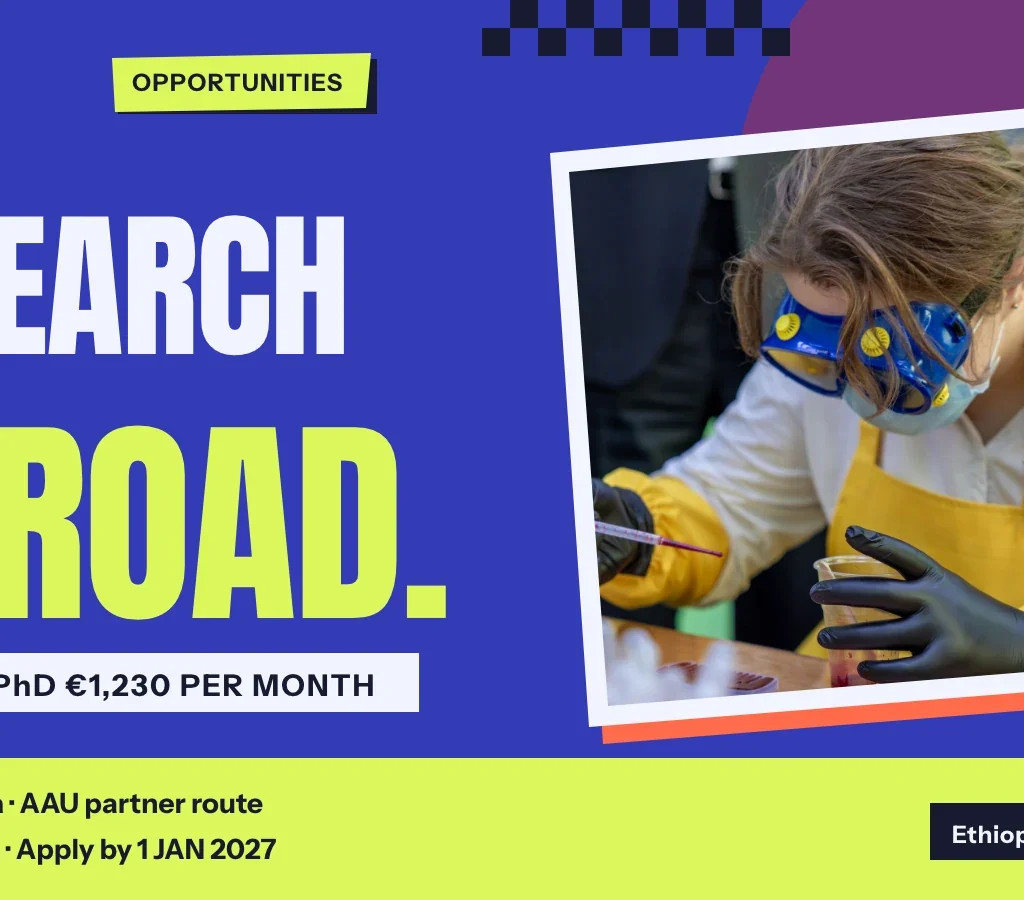
Featured image: laboratory stock photograph by Sergei Starostin / Pexels, used under the Pexels licence and adapted by Aemero Media. It does not depict an INTERACT-Africa participant or a partner-university laboratory.