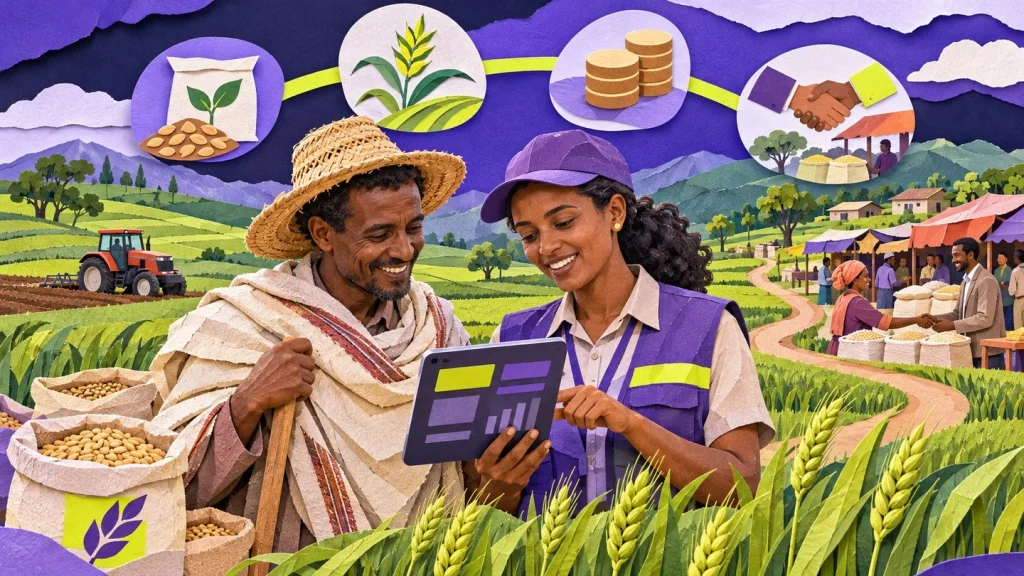
Ethiopian agricultural technology company Lersha and Bayer have agreed to work together on services connecting smallholder farmers with agricultural inputs, financing, advice and buyers. The agreement was signed in Gimbichu, Oromia, on 12 November 2026, during Bayer chief executive Bill Anderson’s visit to Ethiopia, according to Capital’s reporting.
The companies’ stated ambition is to reach nearly 750,000 farming households. That figure describes their intended reach; the announcement does not establish that all those households have already received services or earned higher incomes. Lersha’s own announcement confirms the partnership and its focus on Ethiopian farmers.
What each partner brings
Lersha, operated by Green Agro Solution PLC, provides a digital platform and local agent network linking Ethiopian farmers to services. Its company website describes work around farm inputs, mechanisation, advice and market access. The local network matters because a farmer needs a way to obtain a product or service after receiving information about it.
Under the new partnership, Lersha brings its farmer connections, financing channels and market relationships. Bayer contributes expertise in seeds, crop protection and digital agronomy. The announced model combines support before planting, advice during production and connections to markets after harvest.
For a farmer, those stages are connected. Buying suitable seed can depend on access to money at the right point in the season. Using that seed well can require practical advice. Selling the harvest then depends on quality, timing and finding a buyer. Bringing these services together is the partnership’s proposed approach to those problems.
What the announcement means for Ethiopian farmers
The companies present the collaboration as a way to address barriers to finance, inputs, technical support and reliable markets. Their announcements also refer to the relationship between household health and the ability to maintain a farming livelihood. These are programme aims, rather than independently measured outcomes from the new agreement.
The information reviewed does not set out a farmer application deadline, participation fee, credit interest rate, detailed district rollout or guaranteed purchase price. Farmers interested in joining should use Lersha’s official channels to ask whether the service is operating in their area and which services are available for their crop and season.
Before accepting a linked input or financing offer, useful questions include the total amount payable, repayment dates, delivery arrangements, the party responsible for advice, and any conditions attached to selling the harvest. A partnership announcement alone does not supply those individual contract terms.
What has been announced about local seed production
Capital also reports Anderson’s interest in eventually establishing a Bayer seed-processing facility in Ethiopia. The report gives no committed investment amount, construction timetable or confirmed site. The Lersha partnership and the possibility of a future processing plant should therefore be assessed as separate developments.
The next useful measures will be the areas and crops served, farmers actually enrolled, services delivered and evidence about costs, yields and sales. Those details will show how the proposed network works beyond the signing ceremony.
More from Ethiopia’s startup ecosystem
For other developments involving local ventures, read about Ethiopian climate startups meeting investors and KAMA’s invitation to Ethiopian founders for enterprise pilots. These are separate initiatives with their own participation arrangements.
Featured image: conceptual editorial illustration created for Aemero Media. It does not depict the actual participants, artist or workplace.