The Suri are communities in southwestern Ethiopia. Older travel accounts often call them Surma, a name used by some neighboring groups and outside writers. People may identify more specifically with a community such as Chai or Tirma. Those names are more useful than treating all communities in the region as interchangeable.
What Suri, Tirmaga, Chai and Mursi refer to · Livestock, fields and neighboring communities

Names and livelihoods
Fieldwork among Suri communities has documented livestock keeping, cultivation and trade, with different emphases in different places. Local ties, land access and neighboring communities also shape everyday life. The Suri are distinct from the Mursi, although researchers have documented shared practices and long-standing contact in the wider region. Field research on Suri communities · Omo–Turkana research collection

Dress and adornment in context
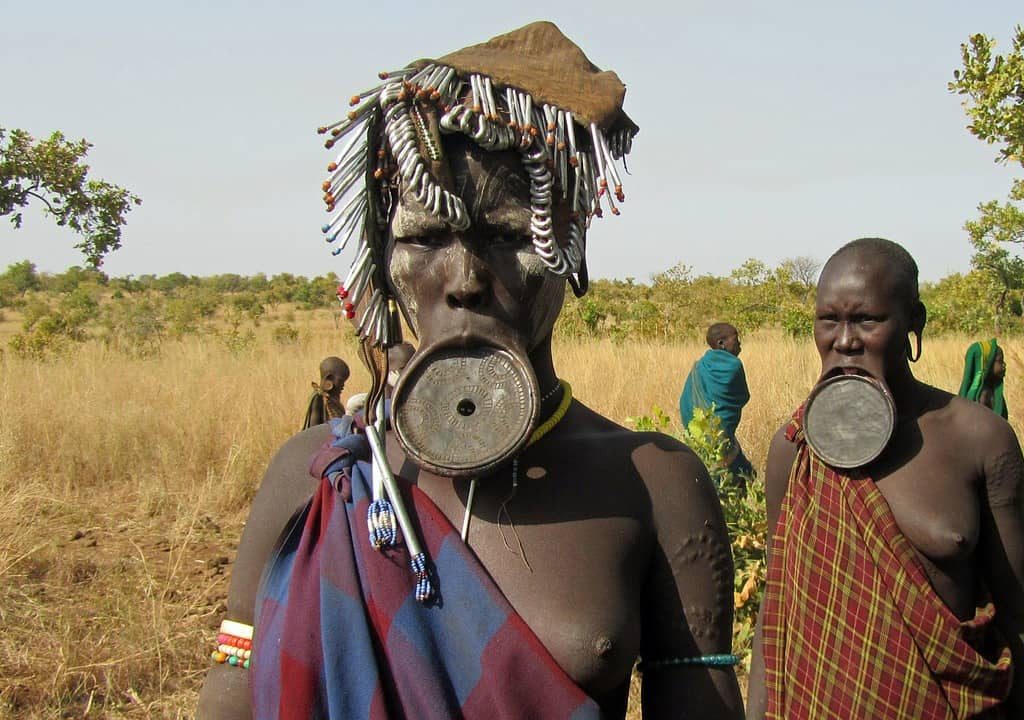
Some Suri women have worn lip plates, and forms of body painting and adornment have been documented. These practices vary by person, place and generation. Travel photography often emphasizes what is visually striking and gives little space to ordinary life. Fieldwork with hosts and visitors records how tourism can influence what people are asked to show. Jon Abbink’s research on Suri tourism encounters


What Suri, Tirmaga, Chai and Mursi refer to
Tirmaga and Chai are names used for communities and varieties discussed in linguistic work on Suri. Mursi is closely related linguistically, but Mursi communities have their own histories and live in a distinct part of southwestern Ethiopia. The word Surma has also been used by outsiders in more than one sense. If a book uses it, look at which people, place and period the author actually describes. Read the geographic context of the Lower Omo. Oxford Handbook chapter on Suri language.
Livestock, fields and neighboring communities
Cattle keeping and cultivation can be part of the same household economy. Neither tells you how every household in a region makes a living. Ethnographers also describe longstanding contacts with neighboring communities such as the Dizi. Those relationships help explain why older reports of clothing, ceremonies or conflict need a place and date before readers generalize from them. Field research on Suri and Dizi relations.
If you plan a community visit
Ask which communities welcome visits and how hosts want them arranged. Request permission before photographing individuals or ceremonies. The Lower Omo Valley guide explains the broader region and the archaeology along the river. For the national context, see our Ethiopian history timeline.