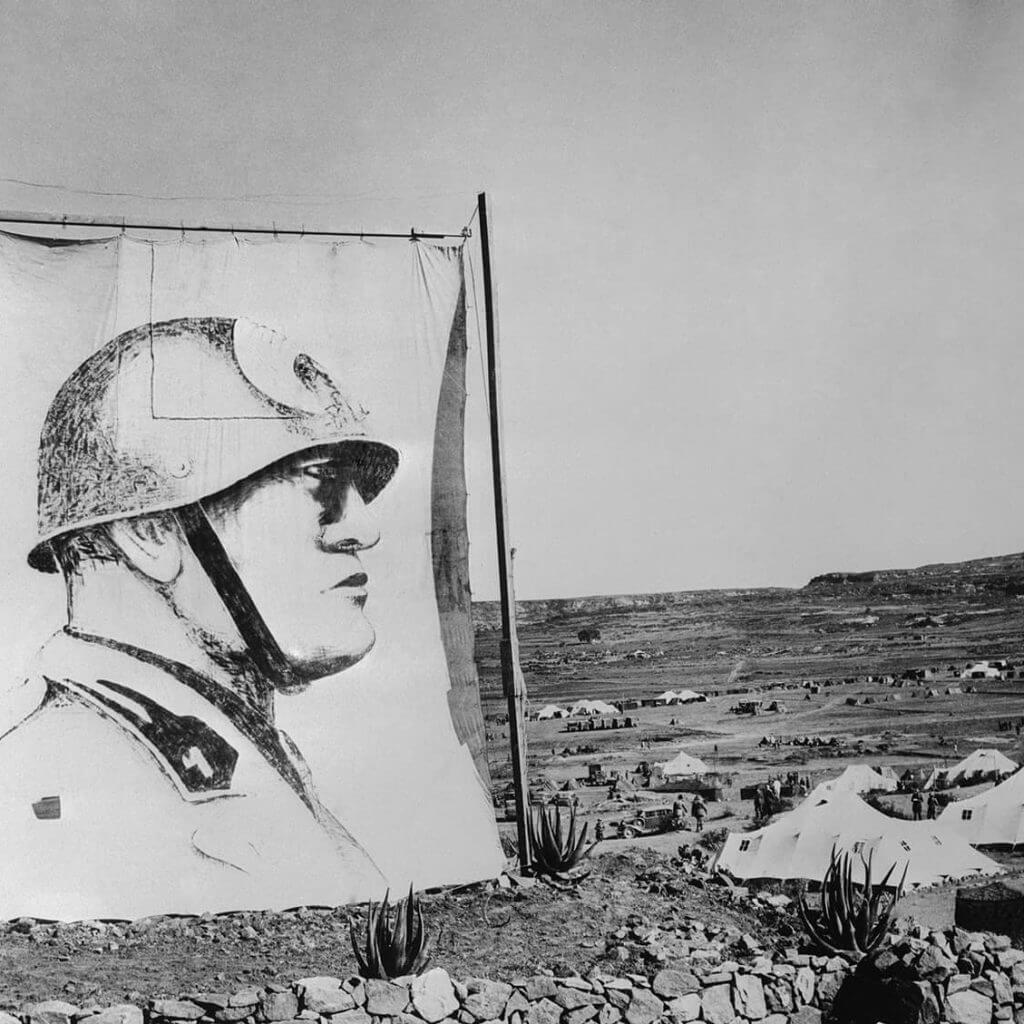
Fascist Italy invaded Ethiopia in October 1935 and seized Addis Ababa in May 1936. It ruled occupied territory as part of Italian East Africa until 1941. The invasion and the occupation were distinct phases of the same war. The first brought down the government in the capital. The second brought years of colonial violence, Ethiopian resistance and an international campaign that ended Italian rule.
On this page: The two wars with Italy · Appeals to the League · Yekatit 12 · Patriot networks · The Aksum monument
1896 and 1935: two wars with Italy
The first war turned on Italy’s claim that Ethiopia had accepted a protectorate under the Treaty of Wuchale. The peace after Adwa set that treaty aside. In 1935, Mussolini’s government pursued outright conquest. Eritrea and Italian Somaliland, which Italy still held, gave it bases on two sides of Ethiopia.
The Walwal clash in late 1934 helped precipitate the crisis. Ethiopian and Italian colonial troops confronted one another at a disputed frontier post in the Ogaden. The U.S. diplomatic records for 1935 trace the dispute and the negotiations that followed. They help explain why some accounts date the crisis to 1934 even though the invasion began in October 1935.
1935–1936: From invasion to occupation
Italy attacked from its colonies in Eritrea and Italian Somaliland. Mussolini’s government sought to expand its empire in the Horn of Africa and overturn the humiliation of Italy’s defeat at Adwa in 1896. Battles at Amba Aradam and Maychew in 1936 weakened Ethiopia’s field armies. Italian forces used aircraft, artillery and mustard gas, including in attacks that harmed civilians. Historian Ian Campbell examines the pattern of violence in his research on Italian atrocities in Ethiopia.
Addis Ababa fell in May 1936. Italy proclaimed an empire and grouped Ethiopia with Eritrea and Italian Somaliland under a single colonial administration. Haile Selassie went into exile and appeared before the League of Nations in Geneva on June 30. In his address to the League, he described the use of poison gas and appealed for collective action. League sanctions failed to reverse the conquest.
What Ethiopia asked the League of Nations to do
Ethiopia was a League member. Its appeal tested whether other members would act when one member invaded another. The League imposed sanctions, but they did not stop Italy’s campaign. In an April 1936 appeal sent to the U.S. government, Empress Menen called attention to the human toll of the invasion. Read it alongside Haile Selassie’s June address, which was delivered after the capital fell. The two appeals show Ethiopia pressing its case both before and after losing Addis Ababa.
The International Committee of the Red Cross archive on Marcel Junod offers a different perspective from the diplomatic record: a relief worker documenting what medical teams encountered. Read it together with the Ethiopian appeals to see what the official arguments about the war meant for people on the ground.
Life under Italian rule and the Yekatit 12 massacre
The occupation government imposed racial segregation and used military reprisals to maintain control. On February 19, 1937, an attempt on the life of Italian viceroy Rodolfo Graziani triggered days of killing in Addis Ababa. The massacre is remembered as Yekatit 12, its date in the Ethiopian calendar. Campbell’s study of the Addis Ababa massacre reconstructs the violence from archival records and testimony. The crackdown continued outside the capital, including the killing of clergy and others at Debre Libanos that May.
Yekatit 12 names the day the violence began; the killing continued for several days. In his study of the massacre, Ian Campbell draws on both archival sources and eyewitness accounts, which offer different ways to reconstruct what happened. The reprisal at Debre Libanos was a separate event in May. The distinction matters because accounts of the occupation sometimes combine atrocities at different places and times. The Ethiopian calendar guide explains why the February anniversary is known by a different date in Ethiopia.
The Arbegnoch kept up the resistance
Ethiopian Patriots, known as the Arbegnoch, organized armed resistance after the capital fell. Abebe Aregai was among the leaders who sustained it in central Ethiopia. Local networks supplied fighters and carried information while the emperor’s efforts in exile kept Ethiopia’s case before foreign governments. Italian forces held the main cities and routes but faced resistance in the countryside. The Library of Congress country study places the Patriots’ campaign in the wider history of the occupation.

What the Patriots needed to sustain resistance
The Arbegnoch depended on people who could pass messages, gather food, guide fighters and shelter them. This local support made it possible for some groups to continue operating even after major Ethiopian field armies had been defeated. It also helps explain why the fall of the capital did not mean Italy had ended resistance elsewhere. See the Library of Congress study of Ethiopia for the wider political setting.
April and May 1941 mark different events. Allied forces entered Addis Ababa in April; Haile Selassie’s return on May 5 marked the restoration of the emperor to the capital, five years after its fall. As the story of the Aksum monument shows, resolving some consequences of occupation took much longer.
1941: The liberation of Addis Ababa
Italy’s entry into the Second World War in 1940 brought British and Commonwealth forces into the campaign in East Africa. With Ethiopian fighters, they rolled back Italian control in 1941. Addis Ababa was taken in April, and Haile Selassie returned to the capital on May 5. Fighting continued in other areas after the capital was liberated. A 1943 diplomatic record describes how military operations continued into November and how questions of sovereignty remained in the postwar negotiations.
Ethiopia commemorates Patriots’ Victory Day on May 5. Adwa, the victory that stopped Italy’s nineteenth-century bid for a protectorate, has its own commemoration. The two dates help explain why Ethiopia’s history is often summarized as “never colonized” and what that phrase leaves out.
The Aksum monument and the long aftermath
Italian authorities removed one of Aksum’s ancient stelae in 1937 and took it to Rome. It was returned to Ethiopia in 2005 and re-erected at Aksum in 2008. UNESCO documents the reinstallation. The case is one concrete example of how the end of military occupation and the restitution of cultural property followed very different timelines. See what the monument originally marked at Aksum for its history before the occupation.