Irreecha is an Oromo thanksgiving tradition centred on gratitude, renewal and the relationship between people, the Creator and the natural world. The best-known large gatherings take place near the end of the main rainy season, when participants come together with green grass, flowers, prayers, blessings and songs. For many people, it is also a powerful expression of Oromo identity and belonging.
Two names appear frequently in announcements: Hora Finfinnee in Addis Ababa and Hora Arsadi in Bishoftu. They refer to different gathering places, with separate arrangements and sometimes different days of celebration. Neither should be treated as a convenient alternative spelling for the other.
Irreecha is more than a colourful event to photograph. Understanding why people approach water, what the seasonal transition means and how the gathering relates to Oromo cultural institutions makes the experience easier to follow. This guide explains those details while recognising that Oromo communities and individual participants do not all understand or practise the tradition in exactly the same way.
What people give thanks for
Waaqa is commonly translated as God or the Creator in explanations of Oromo thanksgiving. At Irreecha, gratitude is associated with passing through difficulty and looking towards a season of renewal. Prayers and blessings can express hopes for peace, wellbeing, fertility, successful work and good relations among people.
The movement from a wet, muddy season towards brighter conditions gives the celebration an immediate physical setting. Rivers and paths may have been difficult to cross; grass and flowers signal renewed growth. These are things participants can see and handle, rather than abstract decorations added to an unrelated ceremony.
The community documents submitted with Ethiopia’s UNESCO Gada nomination describe Irreecha as thanksgiving and as an opportunity for people to meet, greet one another and renew a sense of belonging. They also mention a thanksgiving song, Marewoo. The documents show how community representatives explained the practice; they do not establish one identical script for every gathering.
A helpful way to understand the occasion is to hold its spiritual and social dimensions together. Giving thanks, greeting relatives, hearing blessings and appearing publicly as part of a community are not necessarily separate activities. For many participants, they reinforce one another throughout the gathering.
Why green grass, flowers and water matter
Participants commonly carry fresh grass and flowers, approaching a lake or another water setting during the thanksgiving. Images often show people lowering what they carry towards the water. The action is part of the ceremony, not simply an attempt to make a striking portrait.
The intangible heritage inventory associated with the Gada nomination describes green grass and an indigenous flower known as Ada, also associated with the name Adey Ababa, being placed by lakes and rivers in thanksgiving. This connects the objects to seasonal change and prayer, rather than treating any green plant as an interchangeable festival accessory.
Water is significant both as a physical necessity and within the religious and cultural setting of the ceremony. It supports people, livestock and vegetation, while a recognised ceremonial site carries meanings built through repeated use and community memory. A lake does not become a sacred gathering place simply because it is attractive to visitors.
When observing, allow people room to complete their actions. Do not reach over someone’s shoulders to put a camera in front of their face, move their flowers for a better composition or stand between them and the water. Asking a host what is happening is more respectful and informative than rearranging the scene to match an image you expected.
Hora Finfinnee and Hora Arsadi are separate places
Finfinnee is the Oromo name for Addis Ababa. Hora Finfinnee refers to the city’s Irreecha gathering setting. An announcement for this celebration should be read as a city event with its own approach routes, traffic restrictions and programme, rather than assumed to be the Bishoftu gathering described under another name.
Hora Arsadi, also written Hora Arsedi and in other transliterations, is in Bishoftu, southeast of Addis Ababa. It is especially prominent in accounts of the large lakeside thanksgiving. Bishoftu itself is sometimes called Debre Zeyit in older travel material. Recognising both town names helps avoid thinking that an older source describes a completely different destination.
The Ethiopian News Agency’s report from 4 October 2026 describes the Hora Arsadi celebration in Bishoftu and notes the Addis Ababa gathering on the previous day. These are useful documented examples of the distinction. They are historical dates for 2026, not a booking calendar for every future year.
Before arranging travel, write down the town, gathering place and confirmed date together. “Irreecha this weekend” is insufficient information if people in your group are referring to different events. Our Addis Ababa guide helps orient the city side of a visit; onward travel to Bishoftu needs a separate transport plan.
When Irreecha takes place
The large end-of-rains thanksgiving is commonly associated with the seasonal period called Birraa. Gregorian dates can fall around late September or early October, but it is misleading to present one date as permanently fixed. Community leadership and the year’s official announcements matter.
There are also Irreecha traditions associated with another seasonal transition and with hilltop settings. A field-based study of Irreecha among Shoa Oromo distinguishes Irreecha Tullu, associated with a mountain or hill, from Irreecha Malka, associated with a riverside setting. It compares Hora Arsadee and Hora Bisiil and stresses variation across Oromo areas.
These distinctions prevent a common mistake: taking a description of one famous lakeside gathering and treating it as the entire tradition. A local ceremony may involve another site, another scale and another seasonal emphasis. Ask which practice a source is describing before transferring its details to a different community.
Ethiopia’s weather is also regionally diverse. The seasonal meaning of the central highland gathering does not imply that every part of the country has the same rainfall calendar. Our Ethiopian climate guide explains those differences, which are useful when understanding both the symbolism and the practical travel conditions.
What the 2026 celebrations tell us
ENA reported Hora Finfinnee in Addis Ababa on 3 October 2026 and Hora Arsadi in Bishoftu on 4 October. Its Addis Ababa report and the separate Bishoftu report document a sequence across two days, rather than a single festival moving casually between two venues.
The Bishoftu report describes blessings by Aba Gadas, traditional clothing, songs, prayers and gatherings extending into other public spaces. The specific programme and crowd arrangements belonged to that year. A later visitor should not assume the same entry points, transport restrictions or sequence without a fresh announcement.
Large crowd estimates in festival reporting should be treated with care. Different organisations may count participants at different locations and times, and exact totals can be difficult to establish. The important practical point is that major gatherings can be extremely crowded, not that an unverified number makes one year more culturally authentic than another.
If you are reading this after 2026, use these dates to understand how the two celebrations can be scheduled. Confirm the next edition through the organisers and current local announcements. A hotel, transport company or travel article may repeat an old date even when the coming programme has not been finalised.
How the gathering often unfolds
People arrive in groups, meet relatives or companions and move towards the ceremonial setting. Clothing, grass and flowers make the occasion visually recognisable, but the gathering is also full of ordinary social activity: finding someone in a crowd, greeting acquaintances and making room for older family members.
Blessings and prayers led by recognised cultural or religious authorities form an important part of large celebrations. Singing and collective responses can accompany the thanksgiving. The order, language and local emphasis need to be learned from the particular gathering rather than reconstructed from a short edited video.
At the water, participants may perform their thanksgiving actions and then move away to allow others access. A visitor does not need to follow a person into every space to understand the sequence. Watching from an appropriate distance can reveal the flow of the gathering while keeping the lakeside less obstructed.
The wider day may include socialising, food, music and other public activity. Those elements do not make the prayer a mere opening act for entertainment. Equally, describing only the ceremonial moment misses the community gathering around it. The occasion has several connected parts, and different participants may give them different emphasis.
Gada, Abbaa Gadaa and cultural leadership
Gada is an indigenous Oromo system of governance and social organisation involving knowledge, responsibility, leadership and the regulation of community affairs. It is larger than one annual ceremony. Irreecha appears within the cultural and religious life associated with it, but the two terms are not synonyms.
UNESCO’s description of the Gada system explains rotational leadership, classes progressing through grades, assemblies and the transmission of law, history, ritual and conduct. It identifies an eight-year leadership cycle. That is not a claim that Irreecha itself occurs only once every eight years.
Abbaa Gadaa, with spelling variations including Aba Gada, is a leadership title encountered in explanations of the festival. A traditional blessing carries authority through the people and institutions recognising that leadership. It should not be reduced to a performer reading an entertaining introduction for visitors.
Gada practices also vary historically and regionally. Avoid taking one summary, or the practice of one community, as a complete constitution for every Oromo person. Descriptions of leadership and gender need the same care: consultation and other institutions involving women matter, while formal membership and authority have not operated identically for men and women in every setting.
What UNESCO recognised
The Gada system was inscribed on UNESCO’s Representative List of the Intangible Cultural Heritage of Humanity in 2016. That is the specific inscription supported by the UNESCO record. Irreecha is discussed in associated documentation, but it should not automatically be advertised as a separately inscribed UNESCO element.
Intangible heritage means living knowledge, practices and forms of expression transmitted by people. It is different from a World Heritage property such as a historic town, archaeological site or national park. Recognition of a governance tradition and recognition of a physical landscape follow different UNESCO programmes.
Our guide to Ethiopia’s UNESCO heritage provides wider context, but categories need to stay clear. A list of World Heritage sites should not count a festival or the Gada system as another physical site merely to increase the number of Ethiopian entries.
Recognition also does not freeze a practice in one form. Communities continue to discuss, transmit and adapt their heritage. The essential question is how people sustain the knowledge and relationships involved, not whether every participant dresses identically to a photograph taken in the year of inscription.
Clothing, language and a sense of belonging
Many participants wear clothing associated with Oromo cultural identity, often with distinctive woven details and accessories. There is no need to claim that every item has one universal meaning across all Oromo communities. Ask the person wearing it or a knowledgeable host before assigning a precise significance to a colour or ornament.
Afaan Oromo is central to the prayers, songs and public expression of the occasion. A visitor who does not understand the language can still notice when a leader speaks, a group responds or a song is repeated. A translation from a trusted speaker adds much more than inventing the words from the movement of the crowd.
The gathering can create a sense of connection among people arriving from different places. That connection does not erase individual differences in religion, age, experience or political opinion. Describing everyone present as holding one identical belief makes a diverse community less understandable, not more.
The useful questions are specific: Who is leading this part? What does this response mean? Is this clothing linked to a particular area? Can I stand here? Questions like these let people explain their own practice while giving a visitor concrete information they can retain.
Spiritual tradition and present-day identity
Irreecha has roots in Oromo religious understandings associated with Waaqa and the natural world. In contemporary Ethiopia, its significance can also include cultural identity, public recognition and community solidarity. These dimensions may overlap rather than compete within a participant’s experience.
Researcher Gemechu Jemal Geda’s study of pilgrimage and religious interaction examines Irreecha within a broader setting of belief, place and social change. Such work is valuable because it records particular accounts and encounters, rather than assuming the tradition can be explained by a single tourist slogan.
Another researcher’s first-person study of Hora Arsadi, based partly on participation in 2013 and 2014, discusses the gathering as a setting of Oromo identity. Its dated fieldwork should not be read as a live description of every detail today, but it helps explain why recognition and belonging can be strongly felt.
Avoid giving the ceremony an exact ancient founding date without evidence. Oral traditions, religious accounts and documented modern history answer different questions. It is possible to respect a practice’s depth and continuity while acknowledging that no surviving record identifies a single first Irreecha gathering.
Remember the 2016 tragedy accurately
Irreecha’s recent history includes the loss of life at Bishoftu on 2 October 2016. A responsible account should not erase that tragedy beneath a purely celebratory description. It remains important to many families and to the public memory of the gathering.
Human Rights Watch’s 2017 investigation drew on interviews and video evidence and reported that security-force actions, including tear gas and the discharge of firearms, triggered panic and a deadly stampede. Authorities disputed aspects of responsibility, and reported death totals differed. An uncontested exact toll should not be invented.
The tragedy does not define every part of the tradition, but it helps explain why some participants approach the gathering with remembrance as well as thanksgiving. A visitor should not assume that political expression, grief and religious observance occupy neatly separate spaces in people’s lives.
When discussing the event, identify the date and source rather than repeating an unattributed claim. Avoid using distressing images merely to make a travel article dramatic. People who died and their relatives deserve the same care with names, context and evidence that would be expected in any other account of loss.
Attend as a guest, not a director of the ceremony
Go with a knowledgeable local host or guide if you are unfamiliar with the setting. Their role should include explaining the occasion, appropriate positions for observing and the day’s arrangements. A guide who promises only the closest possible photographs is not necessarily providing the cultural context you need.
Ask before taking a close portrait, and accept a refusal without negotiation. This is especially important for children and people engaged in prayer. A public gathering does not remove someone’s right to decide whether a stranger should photograph them at close range.
Do not handle ceremonial objects without permission or repeat an action simply because it looks attractive. If you are invited to participate, ask what is appropriate and follow the host’s guidance. Being welcomed does not require pretending to understand beliefs you have only just encountered.
Ethiopian cultural events also differ from one another. Timket centres on Ethiopian Orthodox Epiphany traditions; Ashenda has its own northern festival settings. Familiarity with one does not provide a universal set of instructions for attending another.
Plan for a large lakeside gathering
Choose a meeting point away from the tightest crowd and agree how your group will reunite if separated. Mobile networks may be busy, and hearing a phone in a noisy gathering can be difficult. Write down an essential contact and keep your accommodation details available offline.
Travel restrictions and entry arrangements change from year to year. Check the announced approach routes, parking and return transport before setting out. Do not ask a driver to stop in a moving crowd or assume a road open during an ordinary week will remain open during the celebration.
The water’s edge deserves particular caution. Grass, mud, slopes and crowd pressure can make movement difficult. You do not need to reach the closest point to the lake to appreciate the gathering. Keep away from a densely packed or unstable edge and follow stewarding instructions.
Carry drinking water and suitable footwear, and plan around the needs of children, older relatives and anyone with limited mobility. A general statement that an event is open to all does not establish step-free access at every ceremonial location. Ask about the actual route and a less crowded place to observe.
Give the setting the same care as the ceremony
A gathering beside water depends on the condition of the shore. Keep packaging and food waste with you until there is an appropriate disposal point. Leaving a flower or plant material within an established ceremonial practice is not the same thing as leaving plastic bottles, bags or wet wipes around the lake.
Follow barriers and organised walking routes even when another path looks shorter. Repeated shortcuts can damage vegetation and make a steep or wet edge more difficult for others. A quiet place beyond the crowd may also be an area kept clear for safety or for participants completing a particular part of the ceremony.
If you buy food or souvenirs nearby, agree the price and ask permission before photographing the seller. The surrounding commercial activity is part of people’s work, while the ceremony has its own purpose. Keeping both in view makes it easier to behave respectfully without treating every interaction as either a performance or an opportunity for a photograph.
Read common names without confusing their roles
Irreecha and Irreechaa are spelling variations you may encounter for the thanksgiving tradition. A difference in the final vowel does not automatically identify a separate ceremony. Likewise, Hora Arsadi, Arsedi and Arsadee can appear in different reports of the Bishoftu setting. Match the town and site before assuming the source describes another place.
Waaqa refers to the Creator in the explanations discussed here. Gada or Gadaa names the broader system of governance and social organisation. Abbaa Gadaa is a leadership title. These terms do different jobs in a sentence: a person holding a title may offer a blessing during a ceremony connected with wider cultural institutions.
Birraa is a seasonal term, rather than the name of a particular Gregorian date. Tullu and Malka appear in research distinguishing hilltop and waterside settings. Learning those differences helps a reader understand why two accounts of Irreecha can both be accurate while describing different places and seasonal practices.
Translations such as “spring” and “autumn” can create confusion when copied between Ethiopian seasonal descriptions and northern-hemisphere calendars. Look for the physical transition being described: the end of the main rains, or a different point associated with the onset of rains. That is more useful than deciding that every English seasonal label must match the same months everywhere.
Look beyond a single festival photograph
A photograph can show grass, flowers, clothing and a lake. It cannot by itself explain the prayer, the leadership, the person’s connection to the place or the memories carried into the day. Those details come from listening, reading and giving people room to explain their experience.
The most useful account of Irreecha keeps place, season and community together. It distinguishes Hora Finfinnee from Hora Arsadi, the annual thanksgiving from the broader Gada system and a documented past date from a future announcement. It also recognises variation instead of presenting every Oromo participant as a copy of the same cultural description.
For someone attending for the first time, an appropriate aim is simple: understand what you can, ask carefully about what you cannot and leave the ceremonial space with the same respect you would expect for your own family’s gathering. That approach reveals more of Irreecha than treating it as a set of images to collect.
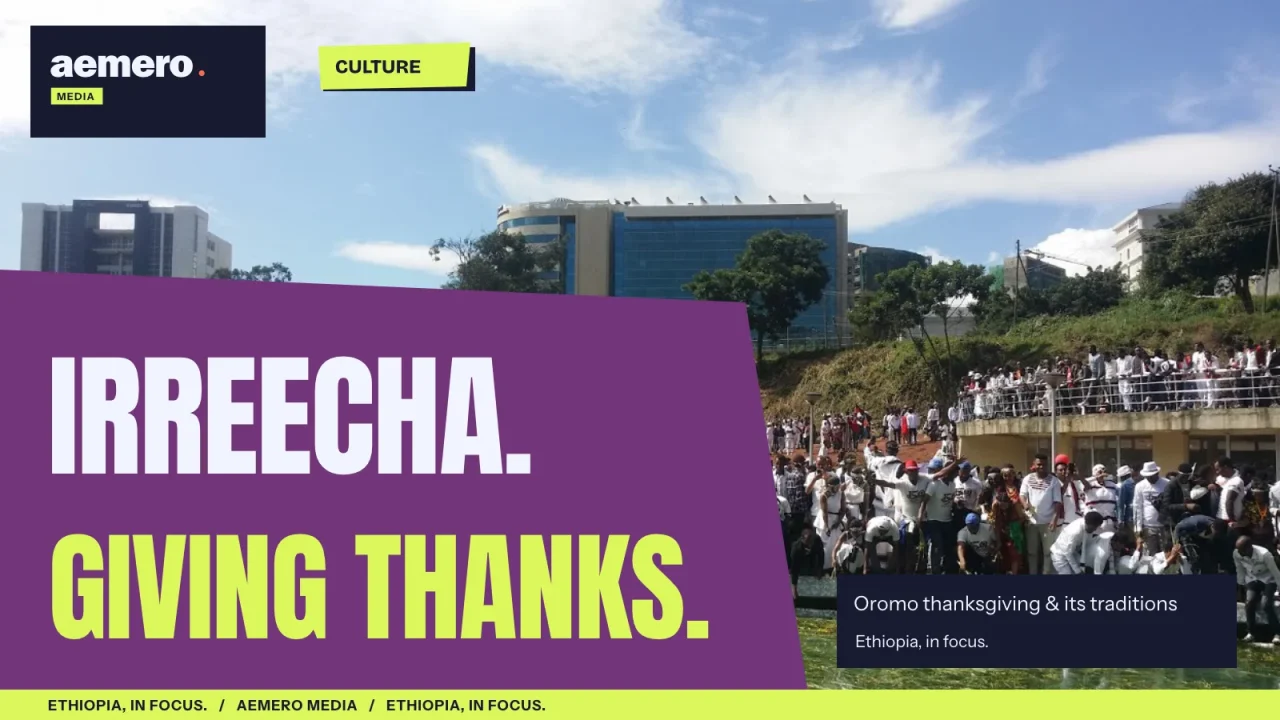
Featured image: Irreecha celebrations in Addis Ababa in October 2019. Mohammed Kassahun, CC BY-SA 4.0. Cropped and adapted by Aemero Media.