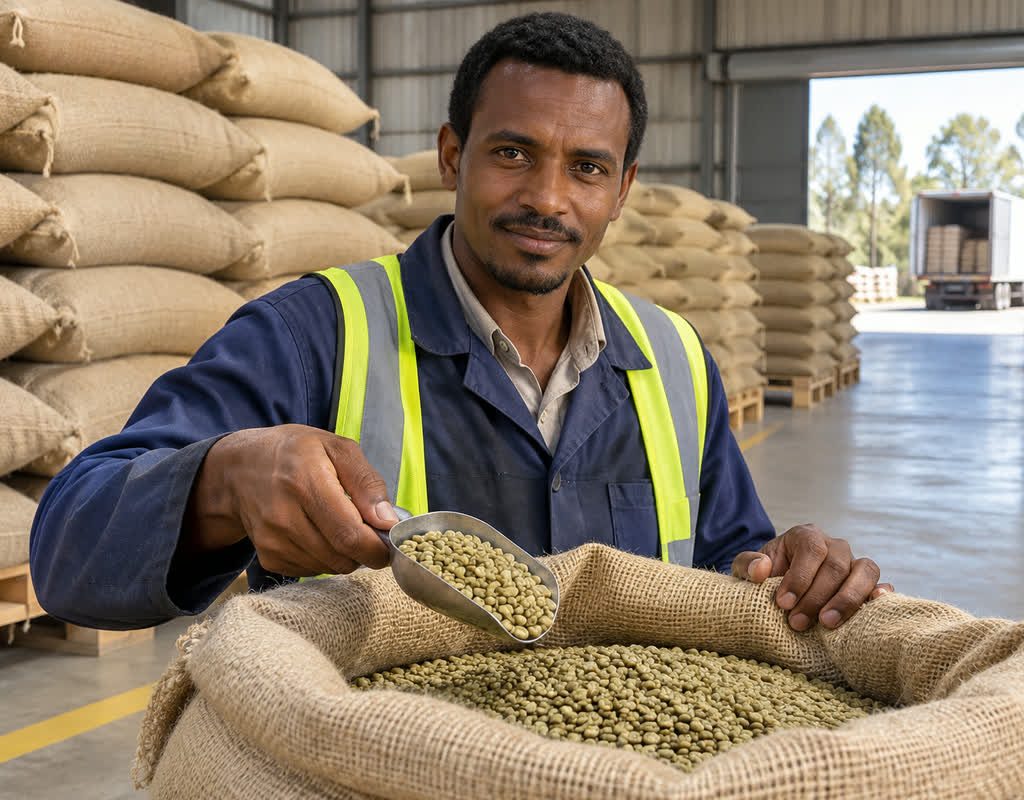
An overseas buyer asking for a price is the beginning of an export sale. The exporter still has to prove which coffee is available, send a representative sample, agree where responsibility changes hands, and arrange for the money to arrive through the banking system. This guide follows a green coffee shipment. For how farmers’ deliveries become an accepted lot, read Part 1 on the cooperative-to-exporter handover.
1. Confirm what your company can export and through which systems
Start with the form of coffee you plan to sell. Green beans, roasted coffee, and retail packaged products can involve different classifications, buyers, packaging and destination rules. Verify the permitted activity, your company’s export licence, applicable certificate of competence, traceable source, and which transactions or warehouse movements the coffee authority expects you to register. The Ethiopian Coffee and Tea Authority’s stakeholder portal asks for exporter or warehouse information. Its online processes cover activities such as dispatch, inventory and compliance. Use the portal and the Authority’s current guidance to establish what applies to your case. Ethiopian Coffee and Tea Authority stakeholder registration · Coffee marketing and quality directives.
Talk to an authorised bank and a customs broker before accepting payment terms. Ask the bank which export application, contract, permit, payment method and supporting records it needs for the shipment. Ask the broker about the current declaration process and which certificates the destination and buyer require. If you are new to trade registration, start with the official business portal. Ethiopian Business Portal · National Bank of Ethiopia export and foreign exchange guidance.
2. Choose a buyer type and prepare a lot they can evaluate
A green coffee importer may buy and consolidate larger shipments. A specialty roaster may want a distinctive small lot and reliable samples, sometimes through an importer already serving that market. A volume buyer may put more weight on consistency, predictable delivery and a price tied to a reference market. For each prospect, record its country, buyer type, whether it imports directly, likely volumes, and the role that signs contracts. Ask what it plans to buy before sending a sample.
Create a specification sheet for each lot. Include the origin and station or farm where traceable, harvest period, process, grade and how it was assigned, lot ID, available net kilos, pack sizes, shipment window and the delivery basis you can quote. Add cup notes from the actual lot and explain what the buyer can verify. Keep the offer date and availability up to date. If a buyer wants 20 tonnes and you have just over two, explain what you can reserve now and what you would need to source separately. Example of how an Ethiopian exporter presents its origins and processing operations.
3. Use a website, social media and direct outreach for different jobs
Make the website the place a buyer can verify your company name, Ethiopian location, business contact, source regions and actual offer. Put up a mobile-friendly page for current lots and a simple form for requesting samples. Ask for company name, destination, importing arrangement, volume, process or quality sought, and buying window. Keep lot specs easy to share in a one-page PDF. Post supply arrangements, photos and certificates only with the necessary permissions and keep farm data in a channel suitable for it.
Use LinkedIn to identify buyers and see which companies already work with Ethiopian origins. Use visual channels such as Instagram to show the season’s actual harvest, drying or sample evaluation, with permission. A post can build familiarity. The sale usually needs a named contact, a sample discussion and written terms. A trade show or public cupping can serve the same purpose if you arrange meetings in advance and can trace the sample on the table to coffee you can deliver. Use a company email domain and a verified direct number once the inquiry turns into business.
Start outreach with a short message. For example: We have an identified washed Ethiopian lot, with 2,040 kg available. If you are buying for your next intake, I can send the lot sheet and ask about your preferred size and delivery basis. Give the contact a reason to reply. Track the buyer, the exact offer version, which sample was sent, feedback, and the next follow-up date. Verify the business through its own website, official registration or independently sourced contact details before agreeing on credit or accepting new payment instructions. Example of an Ethiopian exporter’s public LinkedIn presence.
4. Send and approve the sample before signing final terms
Agree on sample size, courier or freight terms, and any destination paperwork before sending green beans. Label the package and the retained reference sample with the same lot ID. Write down how it was drawn, when it shipped, and what is actually available. Ask the buyer for written feedback. Find out whether approval applies to that sample, the lot reserved against it, or a second pre-shipment sample. If the buyer asks for a different profile, record it as a new request instead of changing the sample description.
Use a signed sales contract or accepted purchase order with the legal names, lot or specification, quantity and tolerance, price and currency, quality checks, claim window, payment requirements and shipping window. Agree who handles local haulage, port costs, main carriage and insurance where applicable. Incoterms can assign delivery responsibilities and the point at which risk transfers. The payment and ownership terms still need their own wording. For container or multimodal transport, consider FCA with a precise named place. Consider FOB only when delivery on board a vessel is the arrangement you actually intend. International Chamber of Commerce guide to FCA and FOB.
5. Price the lot for the agreed delivery point
List what you owe for the accepted green coffee and what you still have to spend under the agreed delivery term. Include sampling and final checks, any extra export packing, inland hauling, terminal or warehouse handling, paperwork, bank costs, financing, insurance and carriage where your contract makes those yours. Use the bank’s applicable currency arrangements and record how you converted local costs for a comparison. Ask the Authority or your bank how to check the current coffee export price floor for that type and grade before signing or registering a contract. A number you read last season can be out of date. USDA Ethiopia coffee report on export price administration.
For the same 2,040-kg lot, suppose the buyer agrees to take all the coffee at a named handover point. The exporter budgets US$10,200 equivalent for the acquired lot, $600 for additional checks and export packing, $350 for paperwork, $450 for inland logistics and handling, and $400 for bank and financing costs. The total is $12,000, or about $5.88 per kg. At an illustrative offer of $6.50 per kg, the invoice is $13,260. The $1,260 difference comes before taxes and any unbudgeted delays, losses, or claims. These are example figures, not a market price or an exchange-rate conversion from Part 1.
Put each expense on a date. If a supplier is due in ten days and the buyer can pay only after presentation of shipping documents, you need enough working capital for the gap. Re-run the forecast with a delayed release or a smaller accepted weight. If the budget only works on the fastest schedule, renegotiate the terms or timing before spending. How to run a weekly cash forecast.
6. Prepare the documents and confirm destination requirements
Build a document checklist with the bank, broker, buyer and applicable agencies. Typical records to check include the sales contract, commercial invoice, packing list, export application or bank reference, customs declaration, grading or quality document, origin certificate where required, and the transport document. An International Coffee Organization certificate of origin can serve a specific purpose under ICO rules. A buyer may also need a different certificate for customs or a trade preference. Ask which exact documents are required rather than using the same certificate for every purpose. International Coffee Organization certificate of origin rules.
Confirm whether the destination requires a phytosanitary certificate or other plant-health documents. Ask how and when inspections must be booked. Use the Ethiopian Agricultural Authority’s certification services and the Ethiopian Electronic Single Window as appropriate. The importer should confirm local import and food requirements before your shipment leaves. If the buyer asks for organic or another certification, verify that the certificate covers the businesses and lot involved and that you can provide any transaction documents the buyer needs. Ethiopian Agricultural Authority certification services · Ethiopian Electronic Single Window.
For green coffee going to the EU, ask the buyer early what farm-plot geolocation and chain-of-custody information it needs for its deforestation due diligence. The party responsible for placing the coffee on that market has its own obligations. The Ethiopian supplier needs to be able to connect the information it provides to the lots being sold. Check the official scope and application dates for the buyer’s situation. European Commission guidance on the EU Deforestation Regulation.
7. Release the coffee, track delivery and close out payment
Confirm the booking and delivery cut-off before sending the coffee from the warehouse. Check bag markings, net and gross weight, lot IDs, and package count against the packing list. Have the warehouse or carrier record the handover and seal number where a seal is used. Reconcile the physical shipment with the declaration and transport document. If the buyer arranged carriage, ask in advance how you will get the evidence the bank or contract requires.
Ask the bank about the benefits and risks of each available payment method, such as an advance or a documentary letter of credit. If using a letter of credit, have the bank check its terms before shipment and make sure you can present the exact documents it requires by the deadline. If you sell on open account, decide how much credit exposure you can bear if the buyer pays late. Independently verify any request to switch bank details.
After dispatch, send the agreed document set through the required channel, track receipt and payment, and compare the amount received with the invoice and bank charges. Check the current foreign exchange rules with the authorised bank, including the deadline for bringing proceeds into Ethiopia, what goes into the relevant account, and what evidence closes the export file. Raise delays with the bank early. Reconcile the buyer’s payment, supplier balances, and any claims before marking the lot complete. National Bank of Ethiopia guidance on export proceeds · Foreign exchange amendment FXD/05/2026.
Before you repeat the sale, record which outreach brought the buyer in, whether the samples matched the shipped lot, what the actual delivery cost, and how long payment took. Use that information to decide what to quote and how much to reserve for the next buyer. For the industry context, see what Ethiopia exports.