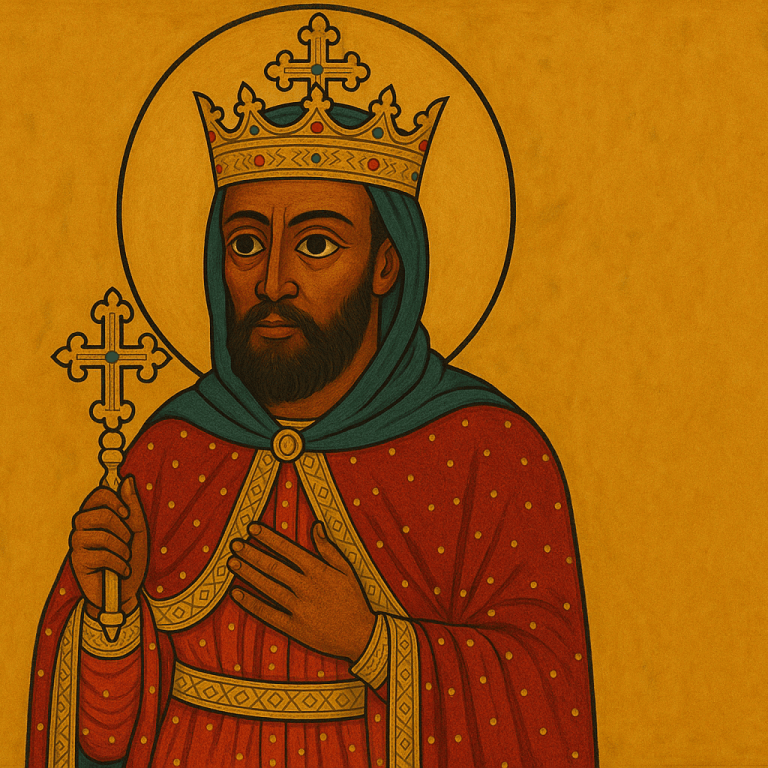
King Ezana ruled the Kingdom of Aksum in the fourth century. His coins record a striking change. Early issues show a crescent and disc. Later ones bear a cross. Together with his inscriptions, those coins provide direct evidence for the Aksumite court’s turn to Christianity.
What to look for on an Ezana coin · Read an inscription as a statement from the court
What we know about Ezana’s early life
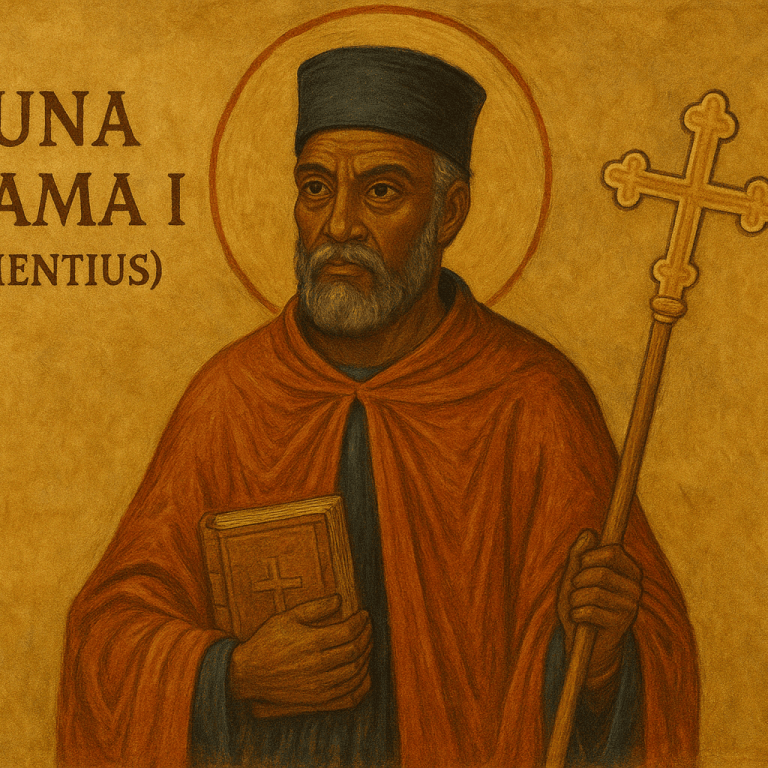
The surviving evidence tells us more about Ezana as king than as a child. His father is usually identified as Ella Amida. Much of the story of the royal household comes from the church historian Rufinus, writing several decades later. He describes Frumentius rising to a position of trust at the court before becoming bishop. The details of Ezana’s early years are harder to establish than the evidence of his reign.

How we know Ezana adopted Christianity
The adoption took place in the fourth century. Pinning it to a particular year is difficult. In addition to the coin designs, a Greek inscription invokes Christ in unusually explicit terms. In a study of Ezana’s inscriptions, scholar Stephanie L. Black examines how the language connects the king’s public profession of faith to theological debates of the period.

A second line of evidence comes from outside Aksum. Roman emperor Constantius II addressed a letter to rulers named Aizanas and Sazanas, asking them to send Frumentius to Alexandria. Athanasius preserves the letter in section 31 of his defense to Constantius. It confirms Frumentius was already recognized as bishop of Aksum by the mid-fourth century.
Ezana’s campaigns and the limits of the record
Royal inscriptions record campaigns and present them as victories. One inscription records a campaign against the Noba in the Nile region. This evidence shows Aksum operating well beyond its capital. The inscription alone leaves open the relationship between Ezana’s campaign and the end of the kingdom centered on Meroë. Like other royal accounts, it tells the story from the ruler’s point of view.

What to look for on an Ezana coin
Start with the ruler’s name and the signs around the portrait. Early issues use symbols associated with earlier Aksumite religion. Later issues carry a cross. A coin can show which imagery the court chose to put into circulation. Reading several issues gives stronger evidence for a change than looking at one piece in isolation. Compare the rulers known through fourth-century coins. Research linking Aksumite coinage to the spread of Christianity.
Read an inscription as a statement from the court
A royal inscription records the language and claims the court wanted to preserve. Ezana’s Greek Christian inscription is valuable because it names Christ in a royal context. Specialists use its wording to discuss the court’s theology. The outside letter from Constantius II addresses a different question about the bishop. Compare the records of Frumentius and Alexandria. Research on the Greek inscription.
Where to see the remains of Aksum
The UNESCO listing for Aksum records its stelae, tombs, inscriptions and the Church of Saint Mary of Zion. Dungur, often called the Queen of Sheba’s palace, is an archaeological site associated with Aksum. The popular name reflects local tradition. For the people and trade behind the monuments, read the history of the Kingdom of Aksum.