Aksum was an inland city with a Red Sea port. From its capital in what is now northern Ethiopia, the kingdom reached the coast through Adulis in present-day Eritrea. Merchants passed between the highlands and the port, where goods entered trade routes that connected Egypt, Arabia and the Indian Ocean. Coins, inscriptions and the stone monuments still standing in Aksum show how the kingdom built and exercised its power.
Follow the route from the harbor at Adulis to the royal mint and the burial monuments at Aksum. The surviving objects help date individual reigns. For rulers named on coins and inscriptions, see the guide to the kings of Aksum.

Where and when the kingdom took shape
Aksum’s center was in the northern highlands of what is now Ethiopia. Its power also reached territory in present-day Eritrea, including the approach to Adulis. These are modern geographic references. The kingdom’s influence varied by period and the evidence is much better for some places than others. The monuments protected at Aksum span several centuries, with UNESCO placing the civilization broadly between the first and eighth centuries CE. UNESCO’s description of the Aksum site.
Earlier settlements and traditions in the highlands form part of the background to Aksum. The appearance of Aksum as a political center cannot be reduced to a single founding date. Archaeologists compare building remains, pottery, inscriptions and objects from trade, which survive in different quantities at each place. Historical and archaeological overview of Aksum.
How Adulis connected the highlands to the Red Sea
The first-century Periplus of the Erythraean Sea, a merchant’s guide to the region, records trade at Adulis. It describes ivory and obsidian among the exports and lists imported goods such as textiles, glass vessels and wine. The harbor and the inland capital were separate places connected by overland routes. Archaeological work at Adulis, summarized in an Oxford University Press study of Red Sea trade, helps place the written account alongside evidence from the port itself.

From the port to the inland capital
The Periplus describes goods reaching Adulis from inland markets, including ivory. At the harbor, ships arriving from elsewhere on the Red Sea brought manufactured goods for sale. A trader visiting the port could describe imports and market arrangements more readily than political conditions in the highland capital. This helps explain why the description of Zoskales is harder to use as a statement about who ruled Aksum itself.
Finds in ports can show contact even in the absence of a written record. Imported pottery or glass tells us that goods moved, while an inscription can tell us who commissioned it or what authority it claimed. Together the two kinds of evidence explain more than either can alone. Archaeological study of the Red Sea and Indian Ocean.
What Aksum’s coins tell us
Aksum began minting coins by the late third century. The issues of Endubis were among the earliest. Aksumite mints struck coins in gold, silver and copper, and their inscriptions and designs changed over time. Gold coins circulated beyond the kingdom, while many copper coins served more local exchange. Archaeologist David Phillipson discusses the coins’ inscriptions and findspots in his study of ancient Ethiopia.

A coin was also a public statement. Earlier issues carried a crescent and disc. On later coins of King Ezana, a cross appears. The change is one of the clearest pieces of surviving evidence for the court’s adoption of Christianity in the fourth century.
Ezana, Kaleb and the reach of Aksum
Ezana’s reign is known from coins and inscriptions in Greek and forms of Ethiopic writing, including Geʽez. An inscription records a campaign involving peoples west of Aksum, and another preserves an explicitly Christian invocation. The career of Frumentius, remembered as Abuna Salama, links the early Aksumite church to Alexandria.

In the sixth century, King Kaleb intervened across the Red Sea in Himyar, in present-day Yemen. An Aksumite campaign followed the persecution of Christians in southern Arabia. The inscriptions examined by historian Christian Julien Robin place those events in a wider struggle over power in late antique Arabia.
Christianity and the languages of public power
Aksumite inscriptions survive in Greek and Ethiopic, and some early inscriptions also use the South Arabian writing tradition. The choice of language and script varied with the monument and intended readership. The changes on Ezana’s coins add a piece of evidence that can be compared with the inscriptions. They are especially useful because they put a Christian symbol on objects made to circulate. Ashmolean exhibition on Aksum’s coins and faith.
The story of Frumentius’s consecration by Athanasius connects Aksum’s church with Alexandria. Coins and inscriptions show what the royal court chose to display publicly. The spread of Christian belief and practice through the population was a different process, and its timing is harder to reconstruct. See the account of Frumentius and the early Ethiopian Church and the coinage evidence.
The stelae, tombs and churches of Aksum

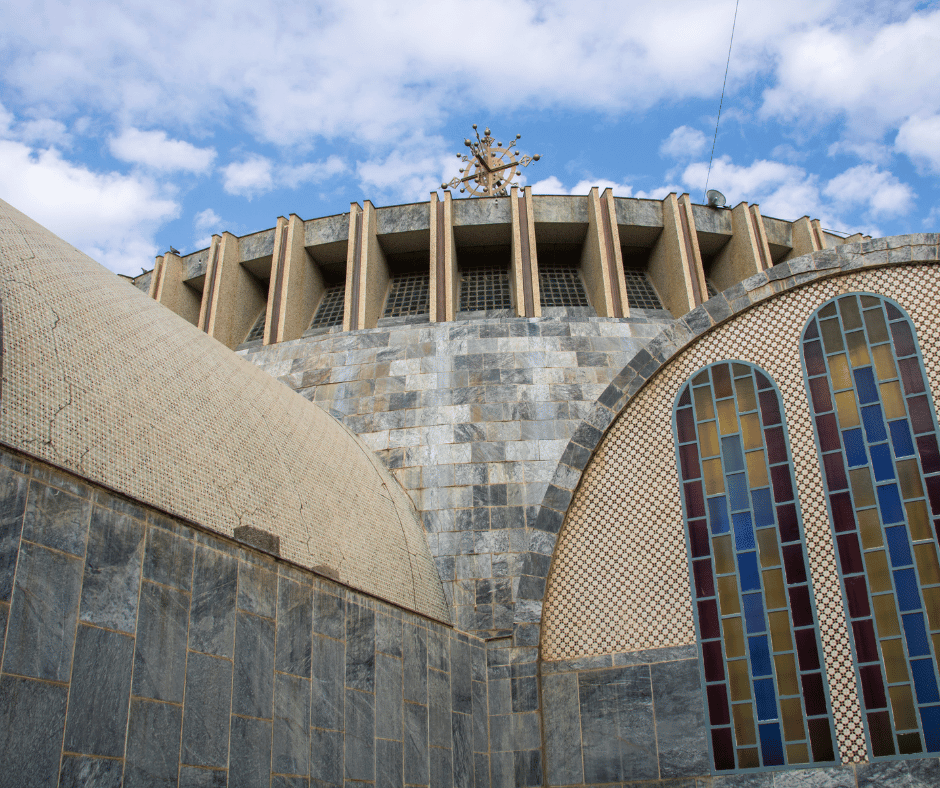
Aksum’s tall stone stelae marked elite burials. Some were carved with rows of windows and doors that imitate multistory buildings. The monuments and nearby tombs are part of the UNESCO World Heritage site at Aksum. The city also contains the Church of Saint Mary of Zion. Ethiopian Orthodox tradition holds that the Ark of the Covenant is kept there.
The returned obelisk and the stelae that stayed
The monuments in the northern stelae field have different histories. The giant fallen stele survives in broken sections. Another tall monument was taken to Rome during the Italian occupation in 1937, returned to Ethiopia in 2005 and re-erected in Aksum in 2008. The latter is often called the Aksum obelisk in accounts of its return. It is one of the carved grave markers described in the UNESCO site record. For the occupation itself, see our history of Italian rule and Ethiopian resistance from 1936 to 1941.
When did Aksum decline?
The kingdom lost influence over several centuries. Archaeological signs of contraction around Aksum appear by the sixth century. Changes in Red Sea commerce and regional politics in the seventh century affected its connections overseas. The evidence points to a gradual transformation, with Aksum’s importance as a religious center outlasting its political and commercial reach. Phillipson reviews the evidence for that chronology in Foundations of an African Civilisation.

The city’s ruins are part of a broader record of Ethiopian heritage. See Ethiopia’s UNESCO World Heritage sites for other places where that history survives.