In Lalibela, you approach many of the churches from above. Roofs sit below the surrounding ground, and steps lead down into courtyards cut into the rock. The UNESCO World Heritage site contains eleven medieval churches. It is also a place of daily worship and one of Ethiopia’s best-known pilgrimage destinations.
On this page: How the churches were cut · Northern group · Southern group and Saint George · Conservation

Why Lalibela is called a New Jerusalem
Ethiopian Orthodox tradition associates the churches with King Lalibela of the Zagwe dynasty, who ruled around the turn of the thirteenth century. Local names echo places in the Holy Land, including the watercourse known as the Jordan. The precise sequence of construction is debated. UNESCO describes the ensemble as a medieval New Jerusalem and documents its continued use by worshippers.
Masons cut trenches into the rock to expose walls, then hollowed out the interiors. In some churches, the walls, pillars and roof are part of a single freestanding mass. Others remain attached to the rock around them. Trenches, passages and tunnels connect parts of the site.
How to tell which parts were cut from one block
Look at the roofline and where the exterior meets the courtyard. In a freestanding monolithic church, a trench separates the block from the rock around it. The builders then carved out the interior while leaving enough of the original stone to form the roof and pillars. In a church cut into the side of a rock face, part of the structure remains attached to the surrounding stone. The Metropolitan Museum of Art’s architectural account describes how these approaches coexist at Lalibela.
The passages also had to carry water away from places cut below ground level. Trenches and drains are part of the design as much as the walls and doorways. The tradition that credits King Lalibela explains the site’s religious identity; the different building forms leave room for more than one phase of work. The history of the Zagwe and Solomonic periods places that tradition in its political setting.
The northern group: Medhane Alem and Maryam

Biete Medhane Alem, the House of the Saviour of the World, is the largest church in the complex. Its rows of pillars give the exterior a different rhythm from the steep, bare walls of the courtyard. Nearby Biete Maryam, the House of Mary, is smaller and has painted decoration inside. Biete Maskal, Biete Denagel and the Golgotha Mikael complex are also in this group.

Use Medhane Alem and Maryam as orientation points: one makes the scale of the carving clear; the other shows what the painters did with the interior surfaces. Then identify Maskal, Denagel and Golgotha Mikael on the site plan. That accounts for all five churches in the northern group. Spellings vary on maps and signs; the UNESCO list is a useful reference if a name looks unfamiliar.
The southern group and Biete Giyorgis

Biete Amanuel stands out in the southern group for its horizontal bands and recessed openings. Its stone exterior recalls the timber-and-stone building tradition of ancient Aksum. The nearby churches include Biete Qeddus Mercoreus, Biete Abba Libanos and the church complex known as Gabriel-Rufael.
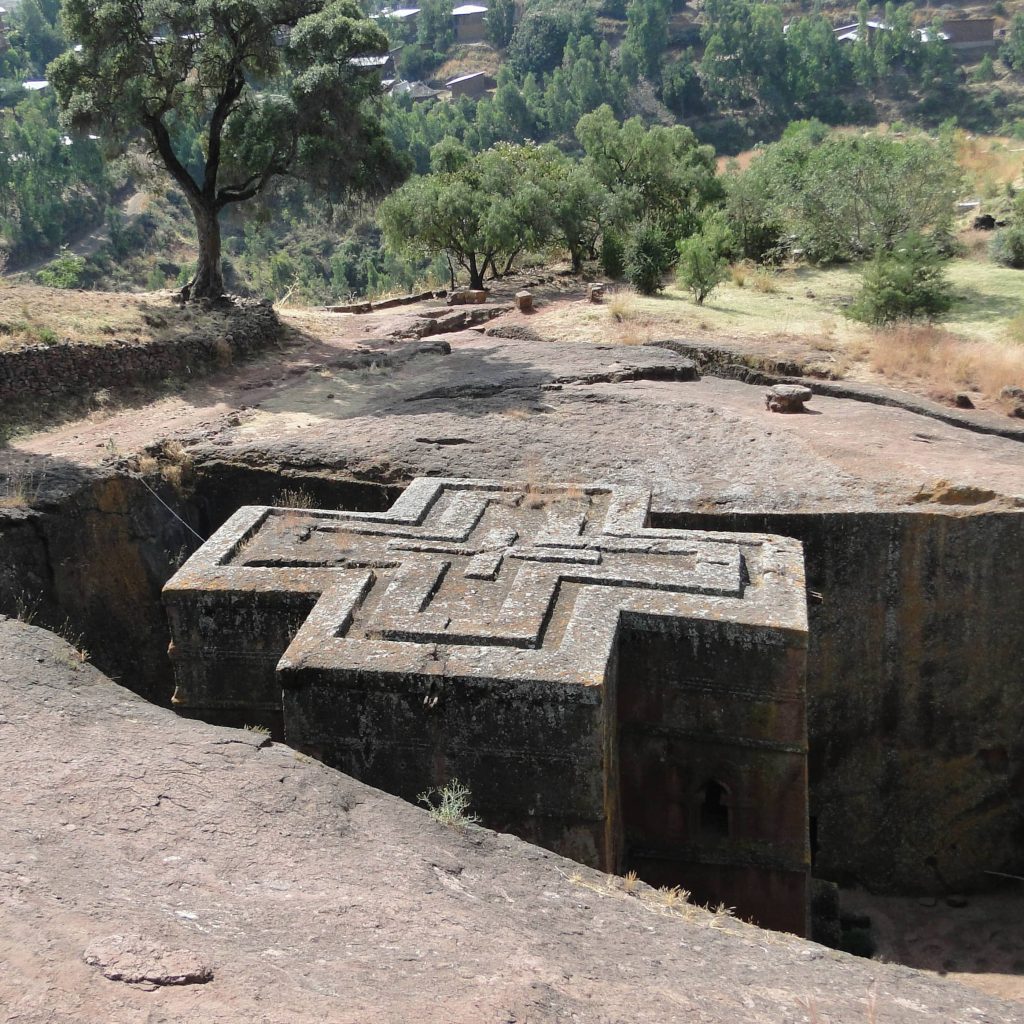
Biete Giyorgis, dedicated to Saint George, stands apart from the two main clusters. Its cross-shaped plan is most clearly visible from the edge of the courtyard. The route down gives a different view, with the church rising from the floor of a deep rock cut.
The full southern group has five churches: Amanuel, Qeddus Mercoreus, Abba Libanos, Gabriel Raphael and Lehem, the House of Holy Bread. At Amanuel, look for the way the cut stone suggests horizontal bands and recessed wall panels; see our closer look at Biete Amanuel for what that style borrows from older building traditions. UNESCO notes that the original functions of Mercoreus and Gabriel Raphael are less certain than their present use as churches. Saint George is the eleventh church, outside the two clusters, with paths and trenches linking it to the rest of the site.
Visiting a working religious site
Allow time for both church groups and Biete Giyorgis. A local guide can explain the different church names and help you find your way through the passages. Ask locally about opening hours and which interiors are accessible that day. Wear shoes that grip uneven stone and can be removed easily. Ask before photographing worshippers or services.
Lalibela remains an active pilgrimage site, especially during major Orthodox observances. Church access can change during services and conservation work. The UNESCO advisory mission report explains why temporary protective shelters were erected over several churches. For context on the religious calendar, see our guide to Timket.
Why parts of Lalibela have protective shelters
Rain can enter through cracks or run down toward the courtyards. Keeping water away from the carved roofs and walls is a conservation problem, not just a matter of covering the site. The UNESCO advisory report discusses the temporary shelters and their effect on the churches and setting. Comparing the rock cuts and drainage with the protective structures helps explain why preserving the site is more complex than repairing an ordinary roof. For another living World Heritage site in Ethiopia, see the Timket setting at Gondar’s Fasilides Bath.