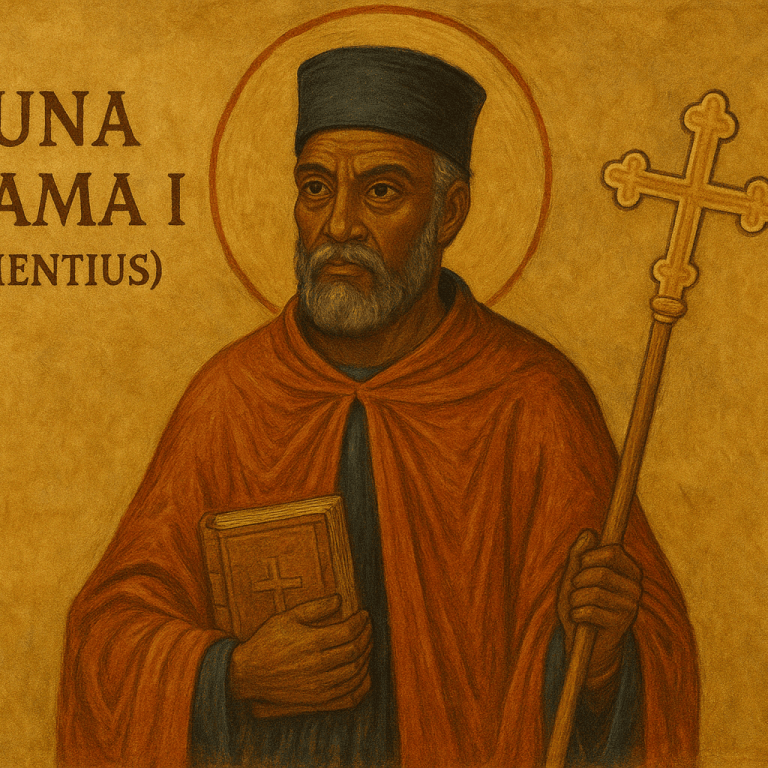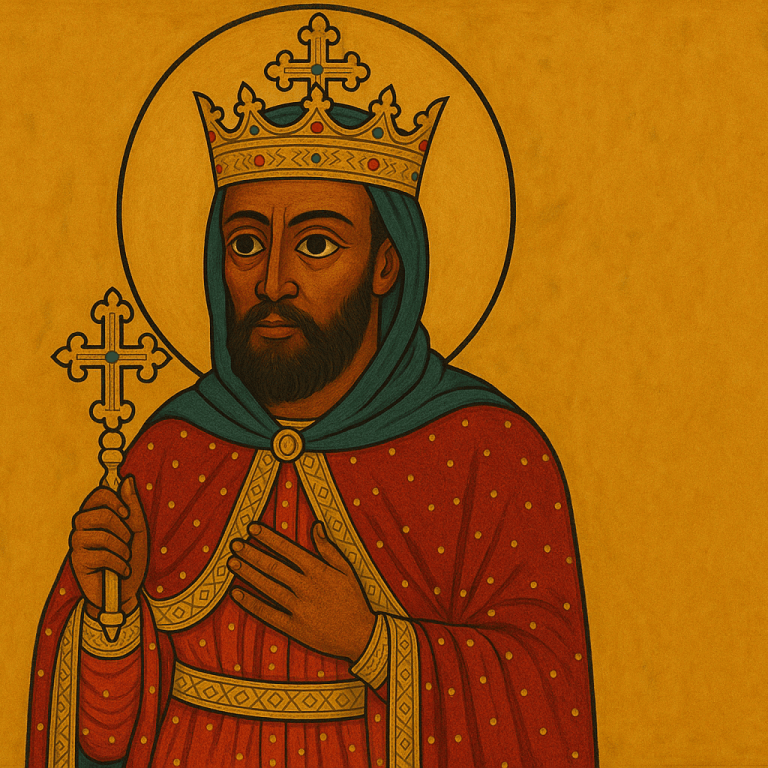
There is no surviving, continuous register of the kings of Aksum. Some rulers are known from inscriptions or coins made during their lifetimes. Others appear in much later traditions. This guide shows what the evidence supports for each name. The portraits are modern illustrations.
Start with the earliest names, then compare the first coin series, the fourth-century issues and the sixth- and seventh-century kings. The history of the kingdom explains why these coins turn up in a story that stretches from the Ethiopian highlands across the Red Sea.
The early names: Zoskales and GDR

The Periplus of the Erythraean Sea, a first-century guide to trade, names a ruler called Zoskales near Adulis. The description is sometimes used to place him in lists of Aksumite kings. Archaeologist David Phillipson argues that the text leaves his relationship to Aksum uncertain.

GDR is on firmer ground. An inscription on a copper-alloy object found at Addi Gelamo names him as king of Aksum. Phillipson discusses the object in his study of Aksumite kingship. The inscription gives a name and title, while the details of the ruler’s reign remain sparse.
The coinage of Endubis and Ezana

Endubis, also written Endybis, is among the earliest Aksumite rulers known from coins. His gold issues help date the beginnings of Aksumite minting to the late third century. Coins tell us a ruler’s name, titles and symbols, even where written accounts of the reign are missing.

Ezana left both coins and inscriptions. The shift from a crescent and disc to a cross on his coinage is evidence for the Aksumite court’s adoption of Christianity in the fourth century. His inscriptions also record military campaigns. See our guide to the Kingdom of Aksum for how this evidence fits into the history of the state.
Aphilas, Ousanas and Wazeba
Aphilas. The Ashmolean dates one of his coins to about 310–323 and places it in the pre-Christian series. The attribution is based on the name struck on the coin. It tells us that he issued currency, while the start and end of his reign depend on how specialists arrange the surviving types. Compare the Ashmolean’s object record.
Ousanas. Coins preserve this ruler’s name in Greek. An early silver specimen catalogued by the American Numismatic Society is dated broadly to 300–330. The broad date range is for the object, so it should not be copied as an exact reign. The catalogue of Ethiopian and Eritrean finds identifies the specimen and its holding institution.
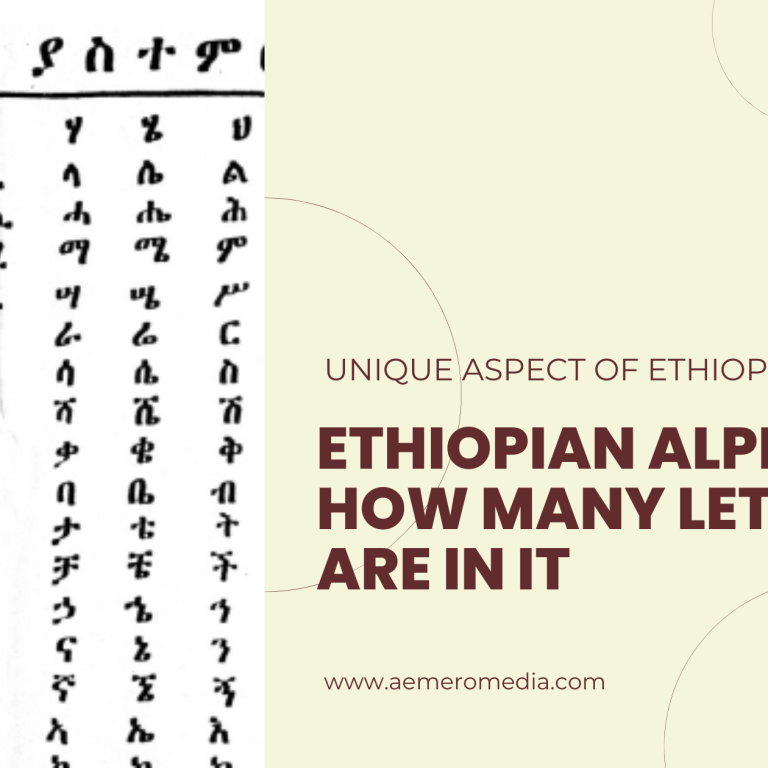
Wazeba. This name is often written WZB in catalogues. Coins associated with him show that the mint could use the local Geʽez script on royal issues. This is an important clue to how the court presented itself to readers. The Ashmolean coin catalogue arranges the series by ruler and illustrates variants. See our guide to Geʽez script and the Ethiopian alphabet for how the writing system works.
After Ezana: what the later coins show
The mint continued after Ezana. Its later series preserves rulers whose lives are much less well documented, among them MHDYS, Ebana and Gersem. A museum might date a coin to the first half of a century or list more than one plausible reign range. A name on a coin, the date assigned by a cataloguer and the sequence proposed by a historian are three separate facts. The numismatist Wolfgang Hahn’s survey explains how revisions to the sequence are made.
The British Museum’s exhibition material identifies a gold coin of Ebana. Compare the object with the earlier symbols discussed in the section on Endubis and Ezana. A surviving coin can establish that a king issued currency even when a biography or royal chronicle has not survived. British Museum exhibition notes.
Kaleb and the later coinage

Kaleb ruled in the early sixth century. His forces intervened in Himyar, across the Red Sea in present-day Yemen. The British Museum’s money gallery guide includes a gold coin of Kaleb. It is a contemporary object from the reign.

Armah is known from copper coins and belongs late in the Aksumite coin sequence. The Metropolitan Museum of Art’s Africa and Byzantium catalogue includes examples of coins attributed to Armah and Endubis. The precise years and succession of several late rulers remain uncertain.
Kaleb, Waʿzeb and the Red Sea record
Kaleb’s intervention in Himyar is visible in sources outside Aksum as well as in Ethiopian traditions. The crossing placed Aksumite authority in a kingdom on the other side of the Red Sea. It helps explain why scholars treat the reign as a high point of Aksum’s overseas power. Waʿzeb is also named in inscriptions and is identified as a son of Kaleb. The sources for a father and son can differ in language, place and purpose, even when both belonged to the same court. Encyclopaedia Aethiopica on the town and kingdom of Aksum.
Names preserved in later traditions

Gebre Meskel and Gabra Masqal are alternative spellings of the same name. In traditions about Aksum the name is associated with a successor of Kaleb. Spelling variants can make one person look like two entries in a king list.


Dil Na’od and Degna Djan appear in later accounts of the transition from Aksum to the dynasties that followed. Their names are worth knowing, but exact reign dates are uncertain. The surviving objects and later traditions answer different questions about the past.

How to check an Aksumite ruler in a museum catalogue
Read both sides. Find the name or title, identify the metal and notice the religious emblem. Then check what the date describes. If it describes the museum’s estimate for that coin, use it to place the object in the wider series. If the record names a findspot, distinguish it from the place the coin was minted. Use the Ashmolean’s Aksum exhibition and the biography of Ezana to practise with a ruler who left both coins and inscriptions. See the names preserved in later traditions for the evidence behind rulers remembered mainly through texts.