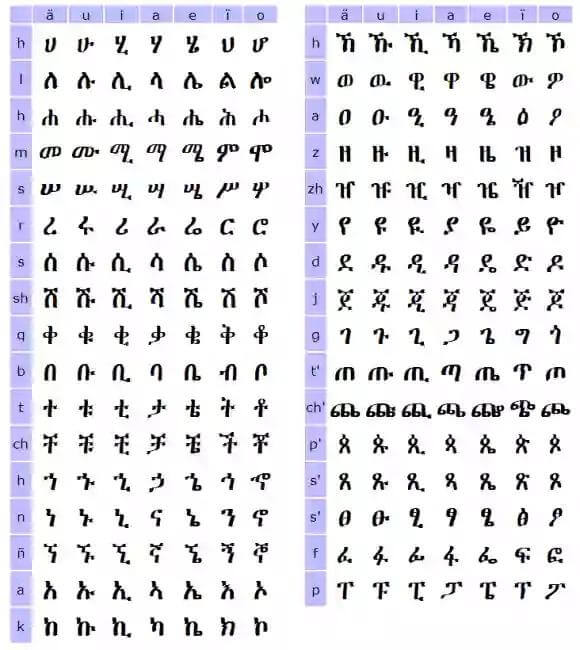
Most beginner Amharic charts teach 33 basic letter series. Each has seven standard forms, called orders. If you already know the Latin alphabet, the useful shift is to look for a whole sound in each sign. In ቡ, for example, you see bu in one character. Change the shape to ቤ, and you get be. This guide shows how to spot those changes, read your first words, and recognize the same script in older Ethiopian texts.
You’ll find this writing system called fidel (ፊደል), Ethiopic, or the Geʽez script. Here, the reading examples are in Amharic. Geʽez is also the name of a language with its own grammar, so knowing the letters is a start, but it will not make a Geʽez manuscript readable as Amharic.
On this page: The seven orders · Five practice words · The history of the script · Punctuation and numerals · How to type Amharic
How to read a letter series
Read Amharic from left to right. Start by finding the consonant family, then identify the form. Linguists call this kind of writing an abugida. In most forms, the sign represents a consonant followed by a vowel. In the sixth order it can instead represent a consonant alone. The vowel is usually built into the character’s shape, so you do not look for a separate vowel letter after it the way you would in English.
The 33 common first forms: ሀ ለ ሐ መ ሠ ረ ሰ ሸ ቀ በ ተ · ቸ ኀ ነ ኘ አ ከ ኸ ወ ዐ ዘ ዠ · የ ደ ጀ ገ ጠ ጨ ጰ ጸ ፀ ፈ ፐ. Each sign here is the starting form of a series. Harvard’s Amharic course outline uses the common count of 33. The Library of Congress chart also lists ቨ for v and forms such as ቧ (bwa). That is why 33 × 7 gives you an idea of the core grid without counting every sign you might see.
A chart also counts different spellings that may sound the same. In modern Amharic, ሀ, ሐ, and ኀ can all stand for an h sound, and ሰ and ሠ can both stand for s. So recognising an h when you hear it does not tell you which series a word uses. Learn the spelling with the word, especially when you start typing and looking up vocabulary.
The seven orders: compare B and M
Learn one row across, then compare the same position in another row. Our Latin spellings use ä for the typical first order and ə for the vowel that can occur in the sixth. Other guides use different symbols for these sounds. The INALCO guide to written Amharic explains the seven forms and shows how small strokes or loops change the sound.
B series: በ (bä), ቡ (bu), ቢ (bi), ባ (ba), ቤ (be), ብ (bə or b), ቦ (bo).
M series: መ (mä), ሙ (mu), ሚ (mi), ማ (ma), ሜ (me), ም (mə or m), ሞ (mo).
Now compare ቤ with ሜ. Both are fifth order and have the same vowel, but they belong to different consonant families. Then compare በ with ባ so you can hear and see the difference between the first and fourth orders in the same family. The shape changes do not look identical in every row. Keep the vowel sequence in mind and learn what each family does with it.
Read five everyday Amharic words
- ቤት (bet), house. Read ቤ as be. Close the word with ት, the sixth form of the T series. Here it is just t.
- ሰላም (sälam), peace or hello. Start with ሰ (sä), follow it with ላ (la), then close with ም (m). You have already seen that final letter in the M series above.
- ስም (səm), name. Both signs are sixth order. The first, ስ, has a vowel here. The second, ም, closes the word with m.
- ቡና (bunna), coffee. ቡ gives you bu and ና gives you na. In spoken Amharic the n is held longer, although the sign is written once.
- ሻይ (shay), tea. ሻ is the fourth form of the sh series. ይ is the sixth form of the Y series. In this word it gives you the final y.
Try covering the Latin spellings and reading the Ethiopic words again. Pay attention to ስም and ቡና: a chart tells you which signs you are looking at, while hearing the word helps with vowels and consonant length. For more words to practice, Harvard’s Amharic food lesson includes coffee, tea, bread, and milk.
Go back to the same five words the next day and read them out of order. If you keep mixing up two signs, write them side by side and name the consonant and the order of each. Then look for a word you can already say, such as your name or a familiar food, and ask an Amharic speaker to check your spelling.
From the inscriptions of Aksum to Geʽez manuscripts
Early Ethiopic inscriptions principally recorded consonants. By the fourth century, inscriptions in the Kingdom of Aksum also show forms that mark vowels. This is something historians can observe on stone: writings associated with King Ezana include examples of the developing script. The University of Hamburg’s Beta maṣāḥǝft guide to Ethiopic handwriting follows that writing tradition from inscriptions to manuscripts.
Geʽez remained a language of books and worship after it ceased to be an everyday spoken language. The Ethiopian Orthodox Tewahedo Church continues to use it in worship. Our article on Abuna Salama and the early Church of Aksum explains how that church took shape. The article on Zara Yaqob’s royal books gives examples of the Geʽez texts that circulated centuries later.
Which languages use Fidel today?
Amharic, Tigrinya, and Tigre all use Ethiopic writing. They have their own spelling and pronunciation rules, so use a chart prepared for the language you are learning. And Ethiopic is one of several scripts used in Ethiopia. Afaan Oromo commonly uses the Latin-based Qubee, and Somali also has a Latin orthography. The language name is the best starting point when you look for a course or a keyboard.
Punctuation and numerals you may see
The traditional mark ፡ can separate words, while ። ends a sentence. Modern writing often uses spaces between words, so you may see ሰላም፡ነው። and ሰላም ነው።. Pay attention to the two marks in the first version: the one between the words and the one after the sentence do different jobs. The W3C’s Ethiopic layout guide explains how these conventions appear in modern texts.
Ethiopic numerals work by combining values. ፩ is one, ፲ is ten, and ፻ is one hundred. Read ፲፩ as 10 + 1, or 11. Read ፪፻፳፫ as 2 × 100 + 20 + 3, or 223. The traditional system has no zero sign. Reading the notation is a separate skill from converting a date, which our Ethiopian calendar guide explains.
How to type Amharic and fix missing letters
Try copying ቤት into a note. If you see empty squares, try a font with Ethiopic support. If the letters appear when pasted but you cannot type them, add an Amharic input method. Some keyboards let you type sounds with Latin keys and convert them to Ethiopic, but the keystrokes depend on the layout. The Keyman Amharic typing guide shows how one of these layouts works. The Unicode Standard documents the characters shared across fonts and keyboards.